SEO in Google – beginner’s guide
SEO – Search Engine Optimization, or search engine optimisation
SEO in Google includes all activities (Search Engine Optimization) aimed at making selected websites appear in high positions in Google’s organic search results for specific keywords.
SEO in practice
When we want to buy a product, we usually start by checking what’s available online – by typing a relevant phrase into Google. Let’s say you’re interested in a rocking chair. You want to buy one, but you haven’t chosen an online store or a specific model yet. So you type “rocking chair” into Google. Here are the results you get: first you see ads, but right below them (marked in red) appear the results for the best-optimised pages for the phrase “rocking chair”. In the case of online stores, their position largely depends on the quality of the product descriptions they provide. The more original the descriptions, created specifically for a given store, the higher the probability that Google will consider them more valuable than those in other stores that only use ready-made descriptions from product databases.
SEO vs. paid Google Ads campaigns
You’re probably wondering why you should bother with SEO tools and spend time on optimising your website for Google when you could just use the paid Google Ads system and appear in the results immediately. There are several reasons for this.
First of all, Google Ads are paid, so your site appears in the top search results only as long as you keep paying. On top of that, to show higher than your competitors, you have to bid more for your ads than they do. The effect of a Google Ads campaign is therefore temporary and fully dependent on your budget, whereas the results achieved through SEO last much longer, even if you later reduce the intensity of your efforts.
Contrary to appearances, not all users mindlessly click the top results, i.e. the ads. More aware users, who are looking for reliable information, often skip paid results. Many people believe that what’s being advertised is not necessarily the best quality.
Of course, this is often not true, but it’s worth acknowledging the behaviour of users who, in search of what they perceive as more attractive offers, click on results that are not marked as “Ad”.
There is a huge number of phrases that users type into Google that no one bids on, because it’s simply impossible to pay for all combinations of less popular keywords. For such queries, no ads are shown at all, or you might see just one or two. In that case, the site that is best optimised organically appears in the top positions.
How long does it take to rank a website?
Getting a website to rank takes time, so when you decide to go down this route, remember that the process won’t take a day or two, but rather weeks. For the most competitive keywords, SEO can even take several months. Fortunately, alongside the most popular and heavily targeted keywords, there are low-competition phrases that are much easier to rank for, with results visible after just a few to a dozen or so days.
That’s why it’s worth starting your SEO strategy with less popular keywords, which will help you reach your first potential customers faster. Then you can systematically add more difficult phrases, which will be easier to rank thanks to the phrases already positioned.
Once you’ve managed to rank your site for a chosen keyword, you can assume that the effect will be long-term. A well-optimised website maintains high positions even if you no longer run SEO activities on as large a scale as at the beginning.
Of course, you should monitor the results you’ve achieved to make sure that Google’s algorithms don’t push your site to lower positions in the search results or that your competitors don’t overtake you with their SEO efforts.
Strengthening high positions is strongly supported by systematically acquiring backlinks from other websites, updating existing publications, and adding graphic or video materials.
SEO – what results does it bring?
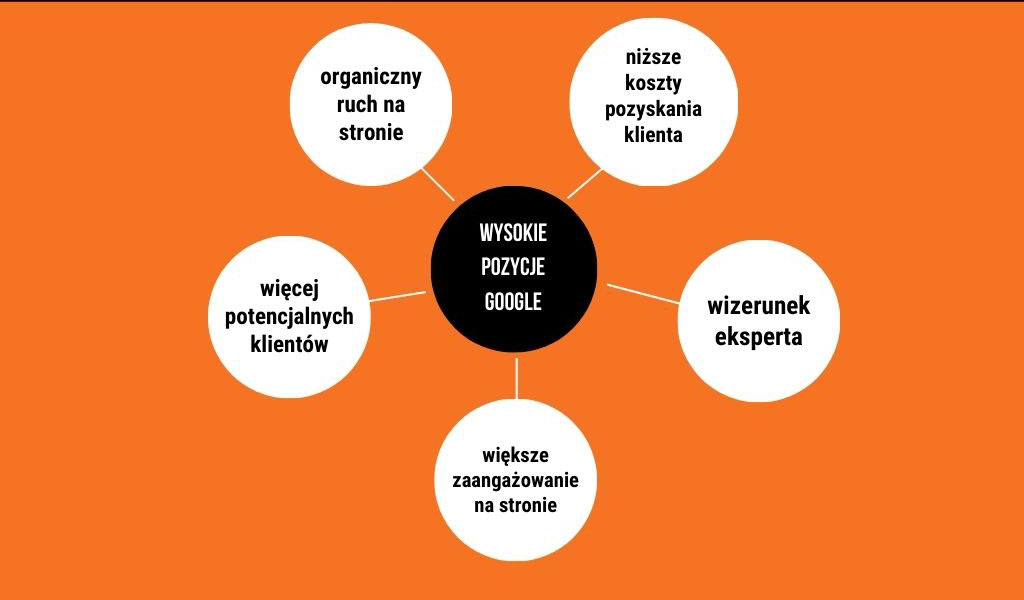
If a website appears organically in high positions on Google, it means that it is properly optimised technically, contains valuable content that responds to specific queries, and has high-quality backlinks from external sites.
High positions are also influenced by attractive, well-described graphic materials as well as audio and video content. A well-positioned website or subpage brings a number of benefits:
-
it appears more often in Google search results, so more users interested in the product or service land on the site
-
increased traffic from an interested audience leads to higher sales
-
thanks to valuable on-site content, you build your image as an expert in a given field
-
you reach a larger audience, which helps you build a recognisable brand
-
users are more willing to use well-optimised and functional websites, spend more time on them, and return to them more often
Website positioning – plan your strategy
The more precisely you plan your SEO activities, the faster you’ll see results. It’s worth preparing an SEO strategy – a set of interrelated actions carried out both on the website and off-site. The strategy can cover a month, six months or a year, but specialists most often choose quarterly planning, because three months is a good timeframe to implement actions and see the first effects.
The next step is to define your main goal and smaller, supporting goals. The main goal could be, for example, a 15% increase in sales over a quarter, with the intermediate goal being an increase in website traffic.

1. Website SEO – technical optimisation
Technical optimisation of a website, alongside valuable content marketing and link building, is the third key pillar of SEO activities.
The technical layer covers changes that make the site more visible and more user-friendly.
The goal of technical SEO is to improve the site’s intuitiveness and speed, optimise its architecture and – which is extremely important today – adapt it to mobile, so it displays and works correctly on smartphones.
Activities involved in technical website optimisation
Technical optimisation speeds up how the website works and at the same time ensures that users have no problems navigating it. As part of technical optimisation, many different actions are carried out. The main ones include:
-
creating personalised meta tags,
-
taking care of the correct HTML document structure and user-friendly URLs,
-
providing the user with a so-called breadcrumb trail,
-
creating a website sitemap to enable indexing of its subpages.
These elements have a positive impact on the site’s SEO and form the foundation for any changes aimed at achieving the highest possible position in search engine rankings.
The result of this optimisation is a significant improvement in page speed metrics (Google PageSpeed Insights) and an increase in the number of subpages indexed in search results. In the long term, this translates into more indexed keywords appearing high in search results.
Ideally, your Google PageSpeed Insights scores for mobile and desktop should be “green”, i.e. between 90 and 100 points.
There’s no need to panic if optimisation only allows you to reach slightly lower scores, because the site speed will still be sufficient for Google to “like” it – and this is only one of the many factors that influence high rankings in Google.
2. Website SEO – content is king
Websites that offer original, high-value content with the right keyword density achieve higher positions in search results than sites filled with low-quality texts mindlessly stuffed with keywords and stripped of context.
If your website contains engaging, unique content, enriched with original images closely related to the topic, and on top of that users share links to specific products and services on your fast and well-optimised site – then the crown is within your reach.
When creating content for websites, expert blogs and social media, remember that your audience consists first and foremost of real people:
-
Don’t copy content from other websites. Even if you offer similar services, describe them in an original and valuable way. It’s often the uniqueness of your description that determines whether a user chooses your offer.
-
Don’t use keywords where they don’t make sense. A high position in search results won’t convince a potential customer to buy if the text doesn’t form a coherent, meaningful whole.
-
Avoid hard-sell copy. Aggressive sales texts are really a thing of the past. Trying to manipulate potential customers simply doesn’t pay off.
-
Engage in dialogue with users. In your publications, try to address topics that are genuinely useful for your audience and potential clients.
3. Website SEO – keyword list
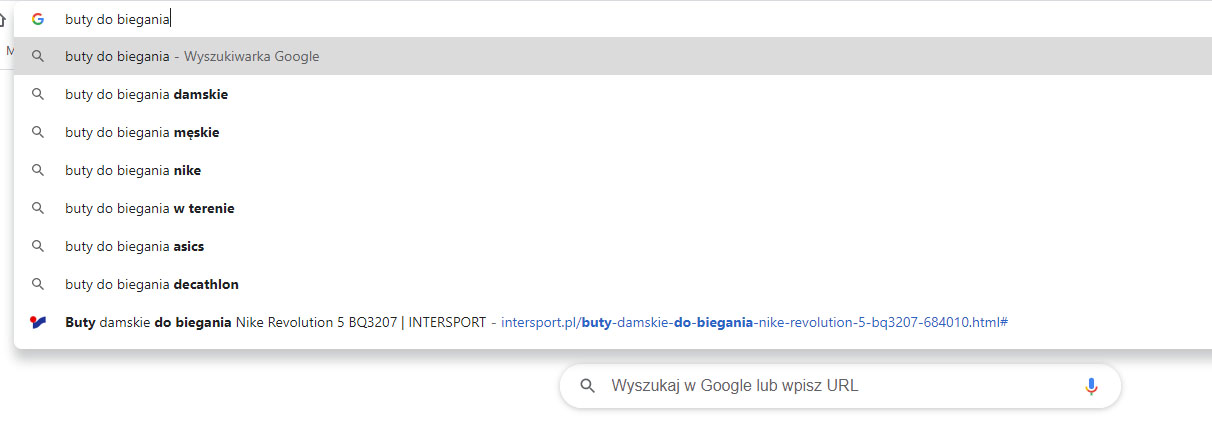
Source: google.pl
When you type a general phrase like “running shoes” into the search engine, Google shows suggestions that include both long-tail phrases (“running shoes decathlon”) and branded queries (“nike running shoes”). Each of these expressions will trigger different search results, tailored to the additional words surrounding the generic keyword.
Keyword phrases in SEO – essential tools
When building your keyword list, tools such as Google Ads Keyword Planner, as well as Senuto or SEMrush, will definitely come in handy.
Google Keyword Planner
Google Keyword Planner is probably the best-known keyword suggestion tool. By entering a searched phrase, you can see not only how popular it is (how many people type it into the search engine each month), but you also receive a list of similar keyword suggestions.
The Keyword Planner is a free tool provided by Google. Its primary purpose is to help plan advertising campaigns in Google Ads, but it can also be used for basic SEO tasks. To get keyword suggestions, you simply enter a base word, and the Planner will display further ideas.
You can also use a domain filter and check a special box if you want the list to include branded keywords as well.
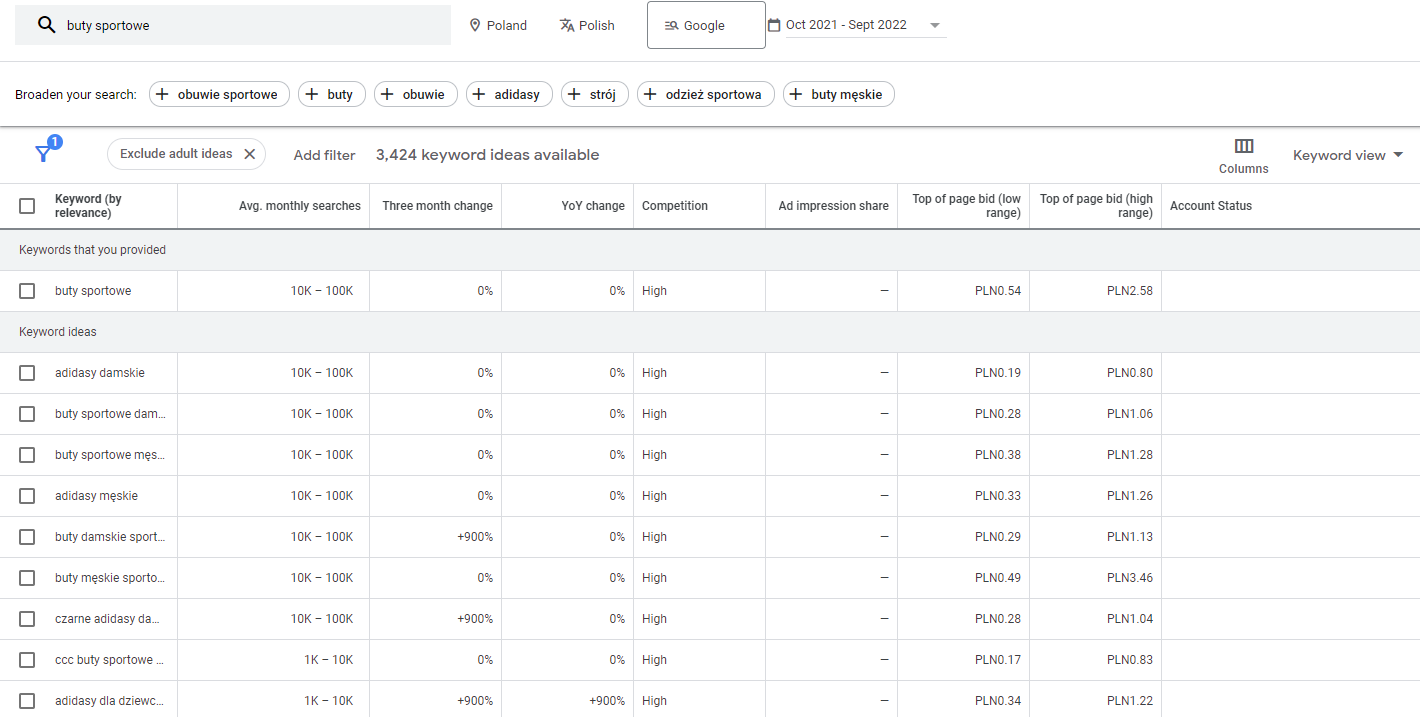
Source: ads.google.com
Senuto – the ideal keyword planner
Senuto is one of those SEO tools that many specialists can’t imagine doing keyword planning without. Although its main module is a visibility analysis tool for a given website, it also has a separate section with a huge keyword database. After entering the main keyword phrase, Senuto will display further suggestions in a narrow match (strictly related to your keyword) or broad match, where the suggestions also include less directly related but thematically relevant phrases.
The search results table itself contains columns dedicated to search volume, trends and the number of words in a given keyword phrase. You can sort and filter results by each of these columns, shaping the dataset as you like. Additionally, by clicking the magnifying glass icon next to a keyword, you’ll get detailed stats and data related to that phrase.
Source: senuto.com
Senuto to płatne narzędzie z możliwością utworzenia darmowego konta na 14 dni.
SEMSTORM
Semstorm is another useful tool in the keyword planning process. After entering a given phrase, you’ll get suggestions divided into several main categories, such as:
-
Simple suggestions – similar to those Google displays in search results.
-
Preposition phrases – a visual map of keywords that include basic prepositions in Polish.
-
Questions – queries asked by users in Google. This is another interesting set that can be very helpful when planning topics for blog posts or articles.
-
Video – keyword phrases that you can include in the title and description of a video to increase its visibility.
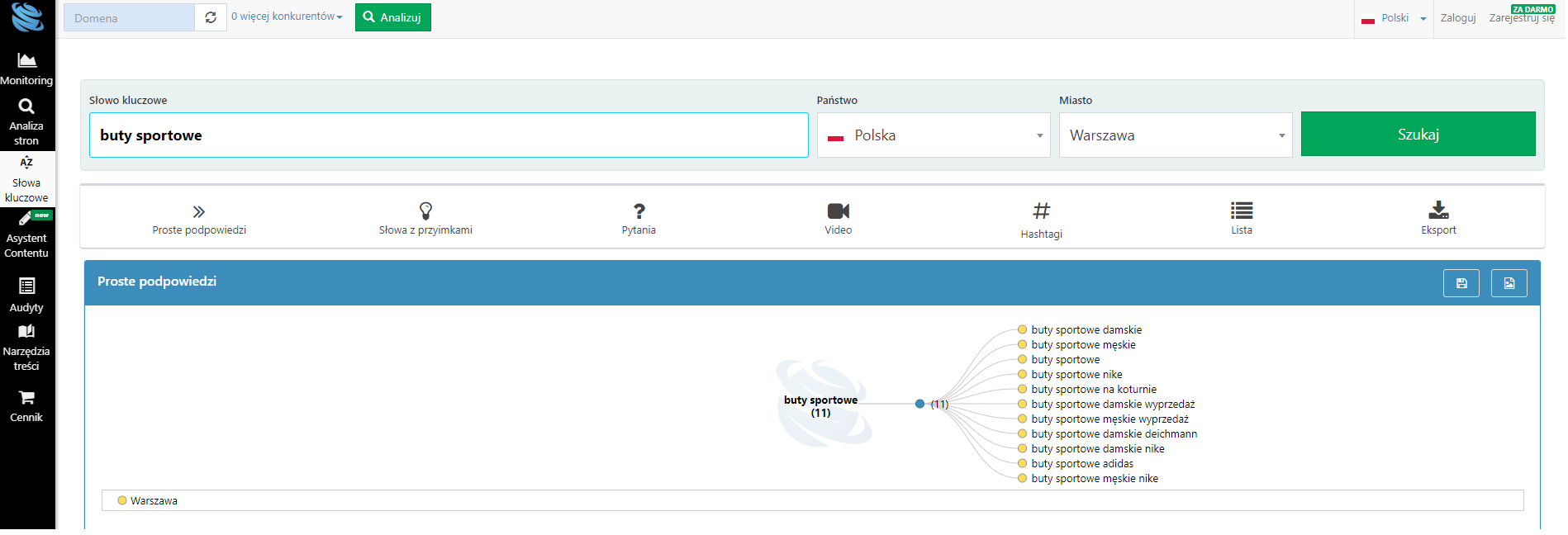
We can generate a report that is a substantial list of keywords sorted alphabetically. You’ll also find groups divided according to the numbers appearing in the phrase – in the case of sports shoes, these are not only specific sizes, but also the years in which particular models were released. Another example of numbers in a keyword is price, which is often included in queries, e.g. “sports shoes up to 100 zł”.
4. Website SEO – an editorial calendar for blog publications
One of the best ways to optimise a company website or online store is to run a company blog. A blog is a place where you can systematically publish new content based on previously selected keywords and key phrases, thereby steadily improving your organic results. Creating an editorial calendar not only makes working on the blog easier, but also motivates you to publish regularly.
A very good solution for planning publications is Google Sheets. The app is free and you can access it at any time – on a laptop, desktop computer or smartphone. All it requires is an internet connection and a Gmail account. The tool is intuitive and clear, and you can freely adapt what you create in it to your needs.
When writing blog posts, it’s worth using WordPress plugins that significantly simplify SEO content work. If you want to know more about other tools that help with DIY SEO, read our article “SEO Tools”. There we describe both paid and free tools that are worth using.
It is essential that your texts are substantive and aligned with the keywords they are created for, interesting, and provide answers to the questions users are asking. They must not contain grammatical, stylistic or spelling errors. SEO is not only about writing new content, but also about updating articles that are already on the blog so they continue to deliver value to readers.
Blog article writing checklist
An editorial calendar can also serve as a checklist for writing blog articles. If you want to boost your website’s SEO with new content, each piece needs elements that directly influence Google rankings. In particular, you should take care of:
-
Keywords – each article should be written around a specific keyword or key phrase. The frequency and context of how you use that keyword has a fundamental impact on how your site ranks in Google.
-
Article title – the title should be catchy and at the same time SEO-optimised, meaning it should include the chosen keyword. In WordPress, post titles are treated as top-level headings, i.e. H1.
-
Subheadings for paragraphs (H2 and H3) – they should hint to the reader what the following paragraphs are about and also include the keyword. Headings help break the text into smaller blocks, making it easier to read.
-
Word count – it has been shown that Google favours articles with more than 1,000 words. Why? Usually, the longer the text, the more thoroughly it covers the topic. Such articles are perceived as valuable, expert content that helps the reader solve their problem.
-
Images, infographics, podcasts and video – all kinds of additional media not only make the text more engaging but are also well indexed by Google, allowing you to reach a wider audience.
-
Internal links – linking from the current article to other previously published posts on your blog supports SEO. It helps Google better index your blog content and, at the same time, sends interested readers to posts that expand on the topic you’re discussing. The effect: readers stay on the blog longer, which also influences how Google’s algorithms evaluate it.
-
External links – Google looks favourably on websites that link out to other high-authority sites. Don’t be afraid to link to 1–2 external sites in an article, but pay close attention to their quality.
-
Publication date – plan your publication dates a few weeks ahead. This will keep you accountable and help you stay consistent.
5. Website SEO – backlink base
Building up a sufficiently large number of external links that point to your site for specific keywords has a huge impact on your results. Algorithms then recognise your website as substantively strong and relevant to that topic. This is one of the most difficult elements to implement in SEO, because it requires you to establish cooperation with websites, portals or bloggers who will place such links on their pages.
Influencer marketing is an integral part of today’s marketing world. However, bloggers existed long before this trend became ubiquitous. By writing about their passion and testing products, they built a large audience of readers. It’s worth reaching out to influential bloggers and influencers in your niche and contacting them to explore possible collaboration. It’s also a good idea to work with bloggers and other niche websites that have smaller reach. Unlike well-known portals with thousands of daily readers, smaller sites are often more open to collaboration. Importantly, the greatest value is not the sheer number of people who see content about your brand, but their level of engagement. Very often, bloggers and influencers have smaller audiences but far more engaged ones, who are much more likely to respond to their content.
6. Website SEO – KPIs and other performance indicators
KPI is an abbreviation for Key Performance Indicators.
KPIs are the most important metrics that allow an organisation to continuously monitor its progress towards previously defined goals. Each KPI should have a numerical value assigned to it, which makes it possible to determine the current state of strategy implementation. In addition, it should be set within a specific timeframe.
Most often, the main goal (i.e. KPI) of website SEO, as well as other marketing activities, is an increase in revenue from the business being run. It is therefore worth precisely defining the revenue value you want to achieve and the time in which you want to achieve it (a specific date).
At the same time, we need to keep in mind that in order to meet the KPI, depending on the type of business and the adopted strategy, you first need to achieve one or more intermediate goals, such as:
-
increase in website traffic
-
increase in net sales
-
increase in average order value
-
increase in conversion rate
-
increase in user engagement
7. Website SEO – measuring effectiveness
Measuring the effectiveness of your SEO efforts is fundamental. There are many tools that allow you to precisely analyse the progress of actions aimed at improving your site’s ranking in Google.
Of course, remember that SEO is a long-term process and you can’t expect your website to appear at the very top of Google after a week or even a month. Most often, results in the form of achieving your KPIs are assessed on a quarterly, half-yearly or yearly basis. You may see the first orders and an increase in traffic sooner, but only after a few months will you be able to tell whether the effect is stable rather than just a short-lived spike.
Website SEO – analytics tools
Google Analytics
The key tool you should use to monitor the results of your SEO is, of course, Google Analytics. Firstly, it’s a very reliable data source, and secondly, it provides a lot of valuable information. From the panel you can learn, among other things:
-
how much traffic your website gets
-
how many people completed a purchase
-
what the users’ purchase paths looked like
-
where your traffic comes from (e.g. social media, paid ads, organic search, external links)
-
what your users’ demographics are
-
what the user engagement rate is
-
how much time users spend on your site
-
which subpages are the most popular – and much more.
Google Search Console
Another free tool is Google Search Console, which lets you check your site’s indexation status and identify errors that appear on it. You can also verify inbound links to your website and see which queries cause a given page to show up in search results. What’s more, you’ll find information on how many clicks each keyword generates.
Mobile-Friendly Test and PageSpeed Insights
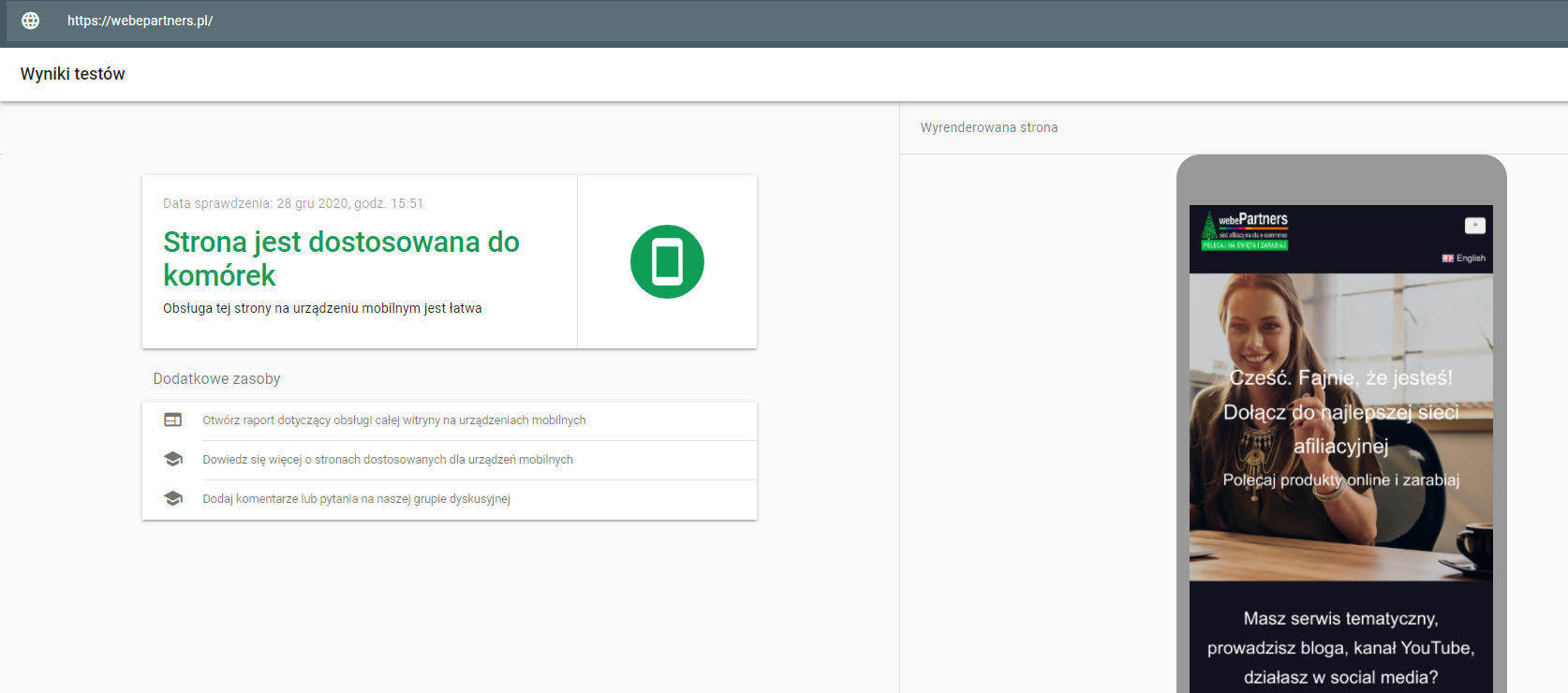
It’s also essential to analyse whether your website is optimised for use on smartphones and tablets, and whether it loads quickly enough. Two more free tools will help you with this – Mobile-Friendly Test and PageSpeed Insights. After entering your site’s URL, you’ll receive a detailed report on how well your website performs, along with precise guidelines on what you should improve to make it even better.
Monitoring tools – Senuto or Seo Station
We also recommend investing in at least one tool for ongoing position monitoring. This will help you stay up to date with how your site is ranking for specific keywords. Examples include Seo Station or Senuto.
Website SEO – do it yourself or hire an SEO agency?
One of the most frequently asked questions is whether SEO really has to be outsourced to an agency. The answer is… it depends.
If you have a lot of time and motivation, and you know you can commit to these activities 100%, you can definitely handle it on your own – at least at the beginning. You can also use an agency’s help only for selected areas, e.g. technical optimisation of the website or acquiring external links.
When it comes to content created for SEO purposes, it’s worth analysing which topics can be outsourced to an external company and which should be developed in-house. To be credible and build trust among your audience, it’s a good idea to publish a series of expert articles around the topics that are most interesting to your potential customers.
In such cases, it’s worth dedicating your own time if you feel like an expert, or finding someone who can cover individual topics in a competent way and provide valuable answers.
If you decide to handle everything entirely on your own, you need to be ready to learn various aspects related to SEO. We’ve prepared a list of 9 blogs, YouTube channels, podcasts and other resources that are worth using to deepen your SEO knowledge.
1. Mayko agency blog
Mayko is a SEM agency with many years of experience in running advertising campaigns in Google. The company specialises in comprehensive promotion of e-commerce in Google search results through online store SEO and effective Google Ads campaigns.
For over 5 years the agency has been running a blog at marketingwsieci.pl. On the blog you’ll find interesting, in-depth articles not only about SEO and Ads, but also about the broadly understood e-commerce industry. There are plenty of valuable step-by-step guides and resources useful for online store owners and e-commerce managers (e.g. ebooks, webinars).
In addition, Mayko is well known in the industry for its annual SEO report, which allows you to see who the SEO leaders are in individual e-commerce sectors.

2. Szymon Słowik Blog – comprehensive SEO support
This blog is an absolute goldmine of knowledge when it comes to website SEO. Szymon Słowik is not only a theorist, but above all a practitioner, as he runs SEO campaigns for many different companies..
In addition to sharing knowledge about SEO, he is also developing the boutique agency TAKAOTO, which has worked with giants such as New Balance, niePrzeczytane, AmRest and National Geographic.
On his blog you’ll find content that’s useful both for beginners – e.g. SEO for WordPress sites or SEO copywriting – and for more advanced readers, including updates to Google’s algorithms and information about Google’s related entities.
Worth checking out:
- SEO Unicorn – everything you need to know
- SEO copywriting – how to write texts optimised for Google search?
- Do links gain or lose power over time?
3. Verseo – Machine Learning in marketing
Verseo is a company that deals with broadly understood marketing, one of whose core pillars is SEO. They operate across different channels, so you can learn in the format you like most.
Of course, you can use their blog – specifically the “SEO” category – where you’ll find lots of articles, such as an SEO glossary, what SEO actually is, and how to correctly interpret conversions in Google Analytics.
In addition, the agency runs its own YouTube channel “Verseo”, where experts discuss topics such as how long SEO takes, what SEO mistakes are most common, and what trends are currently shaping this area of marketing.
Verseo also creates podcasts for users and offers a completely free online course. After signing up, you receive an email with a new lesson every day. It’s a great way to organise your knowledge or build it from scratch! You can get it here: https://verseo.pl/kurs-seo-online-codziennie-jedna-lekcja/
Worth checking out:
4. Artefakt
Artefakt is a Wrocław-based agency whose portfolio includes brands such as TVN, merlin.pl, NeoNet, Bank BGŻ, Da Grasso and many, many others. They really know SEO and are eager to share their knowledge.
In addition to a very active blog, they also run marketing podcasts. They’re not exclusively about SEO, but you can learn a lot from them – for example about changes in Google Analytics, which is also very useful for SEO.
It’s also worth taking advantage of the webinars they organise, each focused on a single, specific topic. They usually last an hour, and the next one will take place on 18/12/2020, where specialists will talk about insights from the past year and trends for the future!
Worth checking out:
- Google Analytics 4 – what will the analytics of the future look like?
- Meta title and its impact on SEO. How to create a good web page title?
- Content marketing and the coronavirus pandemic – 7 reasons why it’s worth investing in content during the COVID-19 outbreak
5. Liczysiecontent.pl
This is a blog run by Agnieszka Wojtas. You can learn a lot from it about how to write so that users are eager to read your articles and Google’s algorithms recognise them as valuable. There are also many other SEO-related topics that will definitely interest you.
Worth checking out:
- Funkcjonalność strony internetowej – dlaczego warto o nią dbać?
- Od czego zacząć pisanie tekstów SEO?
- Długość tekstu na blog – jaka jest optymalna?
6. Senuto Blog
This is the blog of a company that offers a tool extremely useful for SEO activities. In this case, it’s not just an “extra” blog, but a true treasure trove of information about website SEO. It’s not only a source of knowledge, but also a kind of news portal. Senuto experts regularly share all kinds of interesting news related to SEO and more!
Worth checking out:
7. SEO Fridays Podcast
This is the first Polish podcast about SEO, with a very interesting format based on interviews with industry specialists. Dawid Medwediuk, the host, talks to various SEO experts about more advanced topics related to website optimisation, such as JavaScript in SEO or how to handle a crisis. It’s not something to start with as a beginner, but once you’ve learned the basics, it’s definitely worth your attention!
Worth checking out:
- #009: WordPress SEO – Tomasz Stopka
- #004: JavaScript at the service of SEO – Tomek Rudzki
- #003: The most famous Surfer in Poland – Tomasz Niezgoda
8. Fox Strategy
This company not only runs an interesting blog about SEO and SEM, but also publishes a podcast. It’s no longer a show exclusively about SEO, like SEO Fridays, but there’s a lot of content that strongly supports your SEO efforts. You’ll learn, among other things, how to write content for a company blog and what changes are taking place in the Google ecosystem.
Worth checking out:
- #31 DBF – 5 ideas to support your SEO campaigns
- #4 DBF – How to write a company blog?
- #28 DBF – What you need to know if you’re planning to work with a copywriter?
9. Mirosław Skwarek – YouTube
The last, but definitely not least, recommendation is perfect for beginners. Mirosław Skwarek’s YouTube channel is a fantastic place for newcomers. The creator explains various topics such as how to work with the Yoast SEO plugin in WordPress, showing everything step by step. These kinds of tutorials, where you can follow along with a specialist, will certainly make your first SEO actions much easier.
Worth checking out:
- SEO 2021 | 4 clever SEO tactics to beat the competition in Google
- SEO for Beginners: 11 powerful techniques to reach TOP 10 in Google in 2021
- Copywriter’s Workshop #001 – How to write subheadings that make your offer easier to read?
Cooperating with an SEO agency – what’s worth knowing?
Many people decide not to handle SEO on their own and hand over website optimisation to an SEO agency. This is, of course, a good step, but you need to remember that the work such companies do should be at least partially clear to you so that you can verify the results they achieve. It’s worth getting familiar with the specifics of SEO activities, and above all, it’s essential to read the reports sent by your contractors.
A large number of clients send the agency their monthly fee but never once look at the performance reports, assuming they wouldn’t understand them anyway. This is a very bad practice, because it means they’re unable to check whether they are actually getting what they’re paying for.
SEO – billing models with an agency
It’s also important to agree on the right billing model. Some agencies prefer monthly or yearly retainers, while others settle based on results. In the first case, it’s simply a subscription within which specific activities are carried out for your website. In addition, the agency constantly monitors SEO performance and optimises activities in response to changing algorithms.
When it comes to performance-based billing, everything depends on the contract. Usually, it’s settled as the completion of X actions for the site (e.g. acquiring 50 external links) or achieving a specific position for selected keywords. The model you choose should reflect the expectations of both parties.
SEO agency – benefits of working with professionals
Working with a professional SEO agency, where experts in website optimisation are employed, has many advantages. First of all, it saves you a lot of time – but not only that. The agency’s team bases its work on knowledge and experience gained over many years of trial and error and successful SEO projects.
Theoretical knowledge is widely available, as we’ve already shown, but in reality it’s practice that is the key to success. On top of that, you gain security and ongoing monitoring of your SEO efforts.
Remember that poorly executed SEO can lead to the opposite results than expected. You can end up on blacklists and be blocked by the algorithms – and that’s the worst possible scenario. Professional agencies will not allow this to happen and, even if such a problem accidentally arises, they will know how to fix it quickly.
The last point is that experts use professional tools which are often very expensive. So think about what will be more cost-effective for you – buying the tools yourself or working with an agency. The choice is yours.
SEO or Google Ads?
Many people wonder whether, after choosing to focus on SEO in Google, they can give up social media ads or Google Ads. In our opinion, all these promotion channels are strongly interconnected, and it’s worth running activities in each of them, as long as your budget allows it.
Above, we’ve outlined the advantages of SEO over Google Ads, but remember that only part of users will behave this way. The other part will decide to click on an ad, because it’s the easiest way for them to find what they need.
So it’s a good idea to run all these activities in parallel and monitor which ones deliver the best results.