fbpx

Promote your store
and pay only
for actual sales

Generate revenue with the top publishers in the market

VIDEO

Why You Should Become an Affiliate Marketer


Cost Per Sale

1AFFILIATE PROGRAMYou set your own commission for publishers

After registering an advertiser account, an intuitive wizard guides you through the process of launching your affiliate programme. You create a virtual space on the web to collaborate with publishers and account for sales results.

2PUBLISHER NETWORK Publishers promote your offer

The publisher network is made up of a variety of thematic sites and social media users. The webeAds system tracks transactions made from publisher referrals and charges a set commission. You do not incur costs when there are no sales.

3INCREASE IN SALESYou only pay for sales results

Publishers promote the shop's offer on their online spaces, so that advertising appears on multiple, diverse sites simultaneously. The image campaign is an added value to the affiliate activities of the publishers.

The Benefits of Affiliate Marketing


No risk
Payment only for completed orders - Cost Per Sale - commission on sales.


Return on investment
The commission - cooperation model guarantees fixed costs.


Publisher network
No restrictions on the number of publishers in the program.


Customers from referrals
Thanks to publisher referrals, there is an increase in valuable traffic.


Influencer marketing

The multidimensional platform
for marketing activities

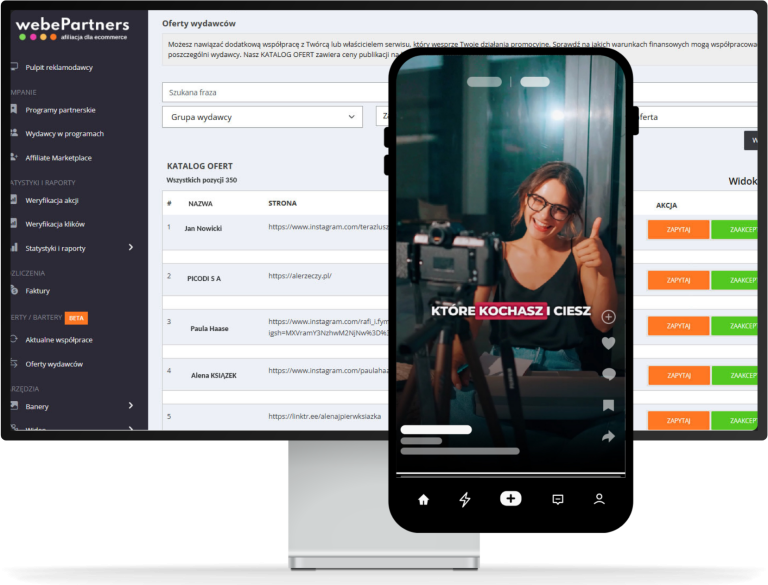
In webePartners, you’ll find a dedicated module for implementing influencer marketing in e-commerce.

Advertisers gain access to a CATALOG OF OFFERS from influencers and online creators for advertising activities under additional billing models. You can choose the best offers and run promotions with well-matched publishers.

Regardless of the billing model, the advertiser always has the ability to measure the effectiveness and conversion value of influencer marketing campaigns.

How to become an advertiser

STEP 1

We sign the contract
and you integrate the service
STEP 2

We launch the
affiliate programme
STEP 3

We engage
publishers in promotion
STEP 4

You pay the
commission on the transaction

Scale your business with our tools

Affiliate
Marketplace


Publishers ready to cooperate in the Cost Per Sale
Discount codes
promotions


Distribution of discount codes and special offers
Links, widgets
files


Free affiliate tools that support online sales
Statistics
reports


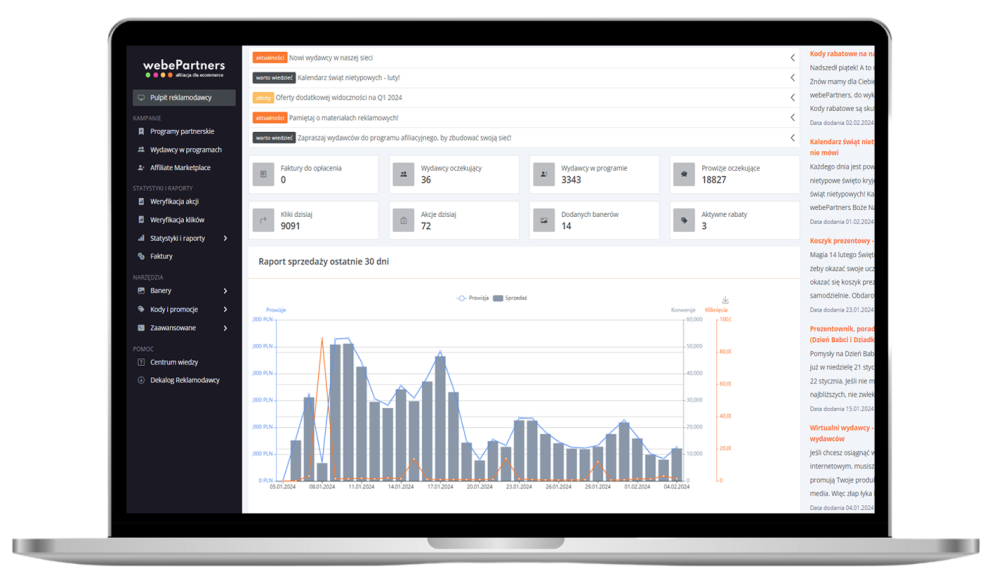
Real-time sales reporting and detailed statistics

webePartners platform

Comprehensive support for large and medium-sized online stores.
The platform offers integrated affiliate tools for running campaigns with publishers. Partner program development is carried out in cooperation with Account Managers and affiliate marketing specialists.

webeAds platform

Affiliate tools for medium- and small-sized online businesses.
The platform enables independent launch and management of a partner program.
Within the platform, you get access to educational materials on developing affiliate marketing as a sales channel for online products.

Affiliate Marketplace

The largest database of online publishers cataloged by category, ad placements, industry, and performance ranking.
The publisher database grows every day as opportunities for affiliate activities expand across diverse online properties and mobile apps.

Influencer Marketing

Dedicated module for implementing influencer marketing in e-commerce. Advertisers gain access to the CATALOG OF OFFERS from influencers and online creators for promotional
activities.
Acceleration and diversification of advertising activities within a single
affiliate platform.

webePartners_logo_bez_tła

Find out more about the benefits of affiliate marketing

Fill in the form and we will contact you


    AFFILIATE ACADEMY FOR ADVERTISERS

    An affiliate program in the Cost Per Sale (CPS) model is a form of affiliate cooperation in which the advertiser pays the publisher a commission only for sales. The advertiser launches the affiliate program, and publishers join it to promote the brand or products and earn money from the transactions they generate.

    The advertiser defines the rules of the affiliate program. These usually include the commission rate, cookie lifespan, transaction validation period, promotion restrictions, and the types of publishers they want to work with. These terms determine how the activities are carried out and how the results are settled.

    The publisher can join the affiliate program while maintaining independence in how they operate. They decide for themselves whether to promote the offer, which channels to use, which affiliate tools to rely on, how intensive their activities will be, and how long they will remain in the program.

    The Cost Per Sale (CPS) model reduces risk for both parties. The advertiser pays for an actual sales result, while the publisher bears no costs or penalties for failing to achieve a specific outcome. This form of cooperation encourages quality-based competition, because the best advertisers attract publishers with attractive terms and transparent rules.

    Below is an even shorter, more “quotable” version:

    An affiliate program in the Cost Per Sale (CPS) model is an affiliate model in which the publisher promotes the advertiser’s offer and receives a commission only for sales. The advertiser sets the program terms, and the publisher independently chooses the method of promotion. The CPS model combines performance-based payment with flexible cooperation and reduced risk for both parties.

    Read more here: https://webepartners.pl/blog/program-afiliacyjny-2/

    Sales grow thanks to an affiliate program because the advertiser’s offer is promoted simultaneously by many publishers across different channels, and the cost arises mainly when the activities lead to a result. This model increases reach, the number of customer touchpoints, and the scale of sales activities while lowering cost risk.

    One of the main reasons for sales growth is additional reach. Publishers reach audiences in places where the advertiser often does not reach on their own or reaches less effectively. These may include content websites, comparison engines, social media, newsletters, offer aggregators, or niche communities. As a result, the offer appears in a greater number of purchase-related contexts and reaches more engaged users.

    The second important factor is recommendations and referrals. Publishers help users make purchasing decisions because they present products in practice, compare offers, explain differences, and provide arguments tailored to the needs of their community. This kind of external recommendation builds trust, shortens the decision-making process, and increases the likelihood of purchase.

    Sales also grow thanks to the scalability of the affiliate model. In an affiliate program, many publishers can promote the same offer at the same time, which increases the number of marketing activities without the need to proportionally increase the advertiser’s fixed costs. In the Cost Per Sale model, the advertiser pays for confirmed sales, not for traffic or impressions alone, which reduces budget risk.

    In practice, an affiliate program combines three mechanisms: greater reach, the impact of recommendations, and performance-based payment. This makes it possible for sales to grow faster, while the activities are easier to scale and measure.

    Read more here: https://webepartners.pl/blog/marketing-afiliacyjny-wzrost-sprzedazy/

    An affiliate program brings not only sales-related benefits. It can also support brand awareness, the development of a publisher network, testing different promotion models, and diversifying traffic sources. As a result, affiliate marketing serves not only a sales function, but also a strategic one.

    One important benefit is increased brand visibility. Even if publishers’ activities do not lead directly to a purchase, they increase the number of user interactions with the brand across different channels. This repeated exposure can strengthen recognition and reinforce the brand in the audience’s awareness.

    An affiliate program can also increase trust in the brand. Recommendations, reviews, and referrals published by independent creators act as social proof. They help reduce purchase concerns, improve the perception of quality, and support customer decisions over a longer period of time as well.

    Another benefit is the ability to test the market and analyze the effectiveness of activities. Cooperation with different publishers makes it possible to check which content formats, products, promotions, messages, landing pages, or advertising materials generate the best results. An affiliate program can therefore serve as an environment for optimization and marketing tests.

    Also important is the diversification of channel risk. Affiliate marketing reduces dependence on a single traffic source, such as paid ads, marketplaces, or search engines. Thanks to cooperation with many independent publishers, an affiliate program can stabilize traffic acquisition and sales.

    An affiliate program can also support the development of business relationships and strategic partnerships. Publishers may include complementary companies, agencies, consultants, tool creators, or industry communities, which opens the door to additional forms of cooperation such as joint promotional campaigns, integrations, or content projects.

    An additional value is building a community and a network of brand ambassadors. An affiliate program can become a framework for cooperation with creators and partners who regularly promote the offer, create content, and provide market feedback.


    Any online store or service offering online sales can become an affiliate advertiser in the Cost Per Sale (CPS) model, as long as it is possible to measure the effect of publishers’ activities from click to purchase. The key requirement is the ability to track transactions and assign sales to a specific affiliate partner.

    To launch cooperation in an affiliate network, the advertiser must integrate their service with the tracking system. This means implementing the appropriate codes or tracking mechanisms at the most important stages of the purchase path, especially where the transaction is confirmed. Thanks to this, the affiliate network can correctly settle sales commissions.

    The group of affiliate advertisers most often includes online stores, because in their case it is easy to measure cart value, sales, returns, and the profitability of activities. Affiliate marketing can also be used by companies offering online services, such as SaaS platforms, hosting providers, marketing tools, educational services, or subscription-based models, if the result is a paid service or activation.

    Affiliate advertisers may also include sellers of digital products, for example courses, e-books, webinars, apps, licenses, or paid communities. In such models, affiliate marketing is often especially attractive due to high margins and simpler sales settlement.

    The CPS model can also be used by reservation-based companies, such as businesses in the travel, events, consulting, or service industries, as long as the reservation can be clearly assigned to the publisher and the commission value can be determined. Affiliate marketing is also used by marketplaces and online platforms that want to increase the number of users or transactions and can settle partners based on the first purchase, account activation, or revenue from the platform’s commission.

    To become an advertiser in the webePartners affiliate network, you need to contact the company, agree on the terms of the affiliate program, integrate your store with the tracking system, and launch the program for publishers. The entire process includes both formal and technical matters, followed by the recruitment of affiliate partners.

    The first stage is contacting webePartners and agreeing on the terms of cooperation. The advertiser receives information about how the network operates, the conditions for launching the program, and the support available at subsequent stages. Next, a cooperation agreement is signed, and the advertiser defines the rules of the affiliate program, such as the commission rate, cookie lifespan, promotion restrictions, and other terms important for the brand.

    The second stage is technical integration of the service with the affiliate system. The advertiser implements the tracking code in their store or uses ready-made integrations available for selected e-commerce platforms. The system should transmit transaction data, including the order ID and its value, so that sales can be properly tracked and commissions can be correctly settled.

    The third stage is launching the affiliate program and starting cooperation with publishers. After the integration is completed, the affiliate network tests whether the tracking works correctly and verifies that transactions are being counted properly. Once the system works as expected, the program is made available to publishers in the affiliate panel.

    After the program is launched, the advertiser also receives support in recruiting and developing the publisher network. Managers help acquire partners, advise on cooperation, and suggest which promotional materials and program terms may increase publishers’ interest.


    The commission rate for publishers in the affiliate program is set by the advertiser. The advertiser decides on the compensation structure, taking into account business profitability, product margins, operating costs, and sales targets.

    The affiliate network or Account Manager may advise on setting rates so that they are attractive to publishers and competitive in the market. However, the final decision regarding commission rates always rests with the advertiser.

    Rates may be modified during the course of the affiliate program. Changes may apply to selected publishers, groups of publishers, specific product categories, or market conditions. Such recommendations are typically based on an analysis of the program’s effectiveness and are implemented in consultation with the advertiser.

    Publishers in an affiliate program are partners who promote the advertiser’s offer online and direct users to their store or website. These can be both individual online creators and large portals, comparison websites, or companies using their own marketing systems.

    A publisher can be any entity that publishes content online and is able to promote products or services using affiliate links, graphics, video materials, widgets, or other affiliate tools. Thanks to this, an affiliate program can grow along with the acquisition of new partners and the optimization of the activities of already active publishers.

    The most common groups of publishers include owners of websites, such as blogs, niche portals, content websites, comparison engines, product directories, ranking sites, and review websites. Discount and cashback websites are also active in affiliate marketing, supporting sales through price promotions and partial refunds of user spending.

    Another important group includes social media creators and influencers who run profiles on Instagram, TikTok, Facebook, Pinterest, or YouTube channels. Publishers can also be owners of mailing databases who promote offers through newsletters and email marketing campaigns.

    The affiliate program is also joined by price comparison websites, product search engines, mobile apps, browser extensions, and recommendation systems that help users find the right offers. Another group consists of specialists using external marketing systems, such as CSS partners, retargeting partners, or media buyers, who use affiliate marketing to run performance marketing activities.

    Read more here: https://webepartners.pl/blog/wydawcy-w-affiliate-marketingu/

    In an e-commerce affiliate program, publishers are most often compensated under the Cost Per Sale (CPS) model, meaning they are paid for sales. This means that the publisher receives payment only when their promotional activities lead to a completed transaction.

    The basis for settlement is a sales commission. Most often, this takes the form of a percentage of the net order value, excluding shipping costs. The commission rate depends on the industry, margin, and the terms set by the advertiser in the affiliate program.

    Commission settlement takes place after transaction verification. This means that the sale must be confirmed by the advertiser, for example after the order has been paid for and the return period has expired. Only approved transactions are included in the final settlement with the publisher.

    Another important element is the consolidated settlement of commissions. In practice, the affiliate network may collect commissions due to many publishers and settle them with the advertiser in a single aggregated invoice. This simplifies administration, reduces the number of separate payments, and makes it possible to handle settlements with one partner instead of many publishers separately.

    This settlement model is popular in e-commerce because it combines performance-based payment, cost control, and simpler financial administration. The advertiser pays for actual sales, and the publisher earns from confirmed results.

    Read more here: https://webepartners.pl/blog/cps-cpl-cpc-modele-sprzedazy/

    Find out more