Earning money on Facebook – how to effectively generate profits in social media
Making money on Facebook with affiliate marketing
Earning money on Facebook is now within reach of every user of the platform. If you have your own fanpage with an engaged community or you’re active on Facebook in any other way, you can start earning right away using affiliate links. By recommending products to your fans on your timeline, in niche groups or in the comments – and attaching affiliate links to those recommendations – you can earn commissions on the sales of the products you promote.

Facebook offers many ways to add active links that direct users to other websites. That’s why earning money on Facebook is so effective. You can paste active affiliate links directly into the content of a post, into the description of an image, video or photo album. You can also paste just the link without any additional text. This means creating posts that contain affiliate links doesn’t require any extra skills. When you create an affiliate post, you act exactly as you normally would – you just additionally attach an affiliate link in the chosen place.
Earning money on Facebook – how to generate affiliate links
After registering with an affiliate network, the publisher receives a unique ID, which is embedded in every affiliate link they generate. The quickest way to create a link is to generate one to the homepage of a selected affiliate program. All you need to do is choose the affiliate program from the dropdown list, then optionally give the link a name so you can easily find it later on the list of all your affiliate links.
Once the link is generated, you’ll be redirected to the “My affiliate links” section, where you can manage your links: copy them, edit them, add extra parameters and analyse the traffic they generate. Now you’ve got your affiliate links ready. All that’s left is to paste them on your website or social media and encourage users to take advantage of what your chosen online stores offer. If a follower, fan or reader clicks your affiliate link and makes a purchase, the order is recorded in the affiliate network’s system and the publisher receives a commission from that sale. This works because the affiliate system tracks the traffic – all clicks on those links – and counts the transactions that result from them.
Generating affiliate links to selected products
In an affiliate network you can create affiliate links to specific products. This is an ideal solution for influencers and online creators who recommend only verified products that are closely related to the topics they cover on their channels.
Earning money on Facebook – an affiliate link as a post
This is a ridiculously simple task. After generating an affiliate link, you place it directly in the content of your post. Once you paste it, you should add an appropriate, prepared graphic (for link posts this is usually 1200×628). You can change the link name by clicking on it and entering your own, as shown in the image below.
Remember to add some copy – a bare affiliate link as a post is unlikely to encourage users to click. Combined with the right content, however, it becomes an effective way to make money on Facebook.
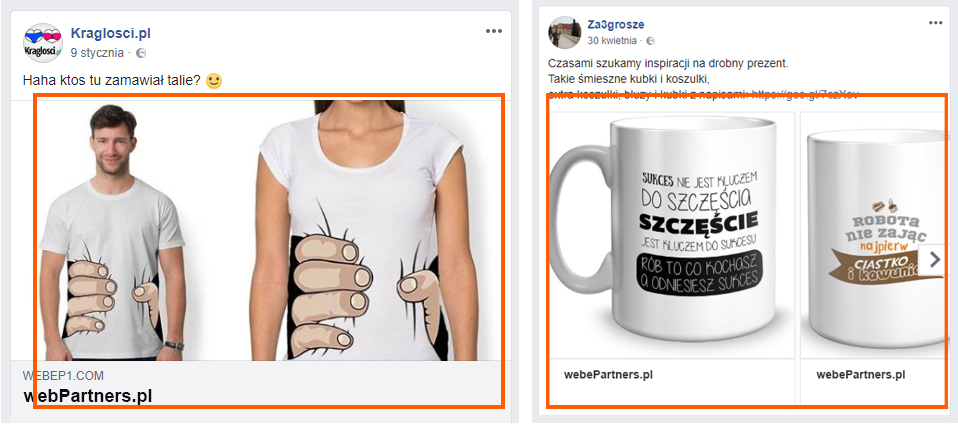
Earning money on Facebook – an affiliate link in the post content
The most popular method is to paste the affiliate link directly into the text of the post. The following example illustrates this best:
Marek runs a fanpage dedicated to TV series. For some time now, he’s been active in affiliate networks and promotes advertisers’ products on his page. Marek knows how to make money on Facebook and recently published the following post:
“House of Cards is an incredibly gripping series about intrigue at the very top of American power. Outstanding acting, thrilling plot, brilliantly written storylines. I wholeheartedly recommend it!”

Earning money on Facebook – multiple affiliate links in Get the look and Must have posts
To trigger as much engagement as possible under your posts – and thus encourage clicks on affiliate links – you should recommend products that are closely related to your fanpage theme and your audience’s interests.
All kinds of outfit ideas and product compilations in formats like “Get the look” or “Must have” work extremely well on Facebook (and not only there). Below is an example from the fanpage of Karina Mrozicka, a stylist who regularly presents interesting styling sets to her female followers. The users get ready-made outfits they can put together in just a few clicks, and Karina earns commissions from their purchases.
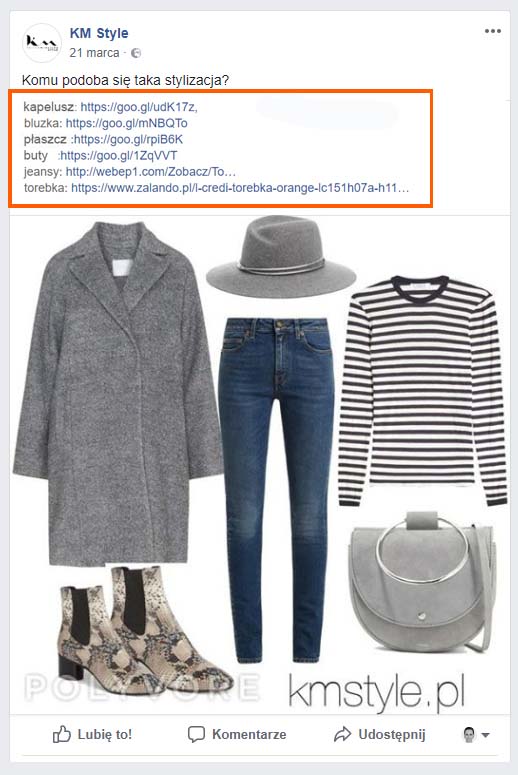
These are just a few basic ways to add affiliate links on Facebook. You can also place links in the photo description, in a comment under a post, or in a message sent via Messenger. The most important thing is to choose products in such a way that your audience clearly sees the benefit for themselves in your recommendations and is happy to click the links.
https://youtube.com/shorts/Ph6ARpy88gE?si=01CC1jmn2kloXTqs
Earning money on Facebook – how to get started
To start earning on Facebook with affiliate links, all you need to do is register as a publisher in an affiliate network. Registration as a publisher in an affiliate network is free (it always has been and always will be), as is access to all promotional tools and the full functionality of the affiliate platform.
This means that once generated, your affiliate links will keep working for you as long as you leave them published on your online channels.

Earning money on Facebook – engagement is what counts
Let’s be honest: in affiliate activities, the most important thing is your fanbase and the trust you build with them. This is a long-term process that requires a lot of work… but the more effort you put into building your own community, the greater the benefits later on.
Before you decide which platform to use to promote affiliate programs, go through all available stats. The number of fans alone is not the only indicator of a channel’s potential – what really matters is their engagement.
Look back at your profile history: does your community react to what you post, and to which types of posts do they react the most? Analyse comments and private messages – this will help you understand what your followers expect. If you recommend products that genuinely interest your audience, earning money on Facebook will only be a matter of time!
Earning money on Facebook and the specifics of social media
You also need to remember that each platform works differently, and this should be taken into account. Affiliate marketing on Facebook can generate significant profits, but you have to make smart decisions about what you want to recommend to your users.
For example, on Instagram, products from categories such as fashion, cosmetics or home decor accessories tend to perform much better. Facebook, on the other hand, is more suitable for promoting broadly understood electronics, computer games, audio equipment, etc. In this case, apart from the promotion itself, a solid and detailed review also matters – something that is harder to fully convey on Instagram. Earning money on Facebook is not particularly difficult – you can place your generated links not only in posts, but also in comments or private messages. Importantly, don’t hide from your fans that you’re earning from these links. If you are honest with them from the beginning, they will definitely repay you with trust and support!
Social media – but what is it really?
Social media are media for social interactions, in the form of an extensive set of communication tools that go far beyond traditional forms of social communication. They have radically changed the way organisations, communities and individual users communicate, and have become a natural place for information exchange.
The main premise of social media is connecting users based on their belonging to a given group, the relationships maintained between them, and the type of information they exchange (texts, photos, videos). Users can create their own profile and decide who they want to show their content to. The general idea of participating in such platforms is to function within a specific social group defined by the user.
The fundamental difference between social media and earlier media is user interactivity. Social media users don’t just want to have, they want to have and be. They have become “prosumers” – a term derived from the English words professional/producer and consumer. Today, we don’t just want to consume content, but actively engage in creating it.
Social media – Facebook
It was created in 2004, and just 24 hours after its official launch the platform already had over a thousand users. Facebook is by far the most popular social medium in the world. It surpassed one billion users in September 2012 and currently has 2.32 billion active accounts (data for 2019). Over one billion of them are users who access the service exclusively via the mobile version on smartphones. The most popular fanpage on Facebook is… Facebook’s own page (214 million fans). Second place goes to Samsung (160 million fans), and third to footballer Cristiano Ronaldo (over 122 million fans on Facebook).
If you’re active on Facebook, be sure to read Earning money on Facebook – how to effectively generate profit in social media?
Social media – YouTube
YouTube was created in 2005, and its main purpose is sharing and watching video content. The platform has been constantly growing in popularity. Many brands noticed the rapidly expanding YouTube audience a long time ago and recognised its advertising potential.
The site allows users to subscribe to their favourite channels and post comments under published content. After Google, YouTube is the world’s second-largest search engine.
If you have a YouTube channel, be sure to read Earning on YouTube – how to monetise even small traffic.
Social media – Instagram
Instagram is one of the most popular and most frequently used platforms for publishing photos and short videos. It is also one of the main channels where well-known personalities (celebrities, bloggers, vloggers) promote products or services of popular brands. The principle of the platform is simple: you take a photo, choose effects and filters, add hashtags and publish. The number of users visiting this social platform each month has already exceeded one billion.
According to data published by eMarketer in 2019, Instagram (owned by Facebook) recorded a 6.7% growth in new users in the US. Analysts point out that this is the first time in history that the increase in US users has fallen below double digits – in 2018 it was 10.1%.
“Instagram has reached full maturity as a social platform and is now going through a phase similar to what Facebook went through some time ago,” explains Filip Cieślak. “The US market is the most developed, so changes like this are usually a signal for the rest of the world. Not directly, of course, but it’s always a trend worth paying attention to. Although in the Polish market it’s still the opposite – Instagram is growing more and more strongly; in 2019 it landed in 2nd place, just behind Facebook. The growth rate of active users between 2018/2019 was higher than between 2017/2018 (Gemius data).”
If you’re active on Instagram, you can’t miss Earning on Instagram – how to generate profits with affiliate links.
Social media – LinkedIn
LinkedIn reached 675 million registered users in the last quarter of 2019 – Microsoft, the owner of the platform, reported in its financial statement published at the end of January 2020. According to the tech giant’s results, the number of user sessions on LinkedIn increased by 25%, which translated into a “record” level of engagement.
LinkedIn makes money through paid subscription models (the platform offers, for example, a more advanced contact search), video courses and ad sales. The company also ties the profitability of the social network to its clients’ recruitment needs. As Microsoft notes in its latest financial report, “someone finds a job on LinkedIn every seven seconds.”
Media społecznościowe – Twitter
Twitter started operating in 2006. Since then, its number of users has been growing almost constantly and currently reaches around 330 million (according to Statista).
Twitter.com recorded around 330 million registered users in 2019. The most dynamic growth period was between 2010 and 2014. Since early 2015, Twitter has clearly stagnated, and the growth in new users is much lower than on other social media platforms.
Social media – do we still trust them?
Steve Bartlett, speaker, founder and CEO of Social Chain Group, in his talk “Affiliate Marketing, Social Media & Authenticity in 2019” opened with data that isn’t very optimistic, but also not particularly shocking – less than 25% of internet users trust what they see on social media. As he admitted himself:
“Social media are now like Times Square – filled with such a variety of content that it’s sometimes hard to separate truth from so-called fake news.”
Another factor responsible for the decrease in trust towards social media, according to Bartlett, is that both marketers and influencers have, for years, prioritised profit over trust – and now they have to pay the price. For this reason, affiliate marketing in social media may seem ineffective. The founder of Social Chain therefore suggests changing the way we think about online presence.
Social media – black box vs. glass box
Brands and influencers who are currently most successful and gaining the most popularity have one thing in common – they have adopted a glass box strategy, especially when it comes to their presence on social media.
Just a few years ago, it was completely normal for all operations, plans or marketing initiatives to exist inside a so-called “black box” – inaccessible to the audience or consumer, discussed only behind closed doors.
Today, brands are betting on transparency. Instead of building walls around themselves, they invite their audience inside, showing how they function on a daily basis, using social media, which usually allows for a less formal presence and closer contact with followers.
As a result, the difference between a company’s internal culture and its external image begins to disappear.
Social media – which channels will bring the most conversions
You might be wondering which communication channels to use to maximise conversions, or as an advertiser, which creators you should focus on. Bartlett predicts that the most effective platforms will be:
-
social media that enable live relations (above all, Instagram Stories),
-
Facebook groups,
-
communication apps such as WhatsApp.
Podcasts are also becoming increasingly popular in affiliate marketing, and brands targeting people under 21 should seriously consider being present on TikTok.
The effectiveness of the first group of channels is largely based on a sense of ephemerality and FOMO – the content disappears quickly, which pushes users to act fast and make impulsive decisions about choosing a specific product or service. Groups build a sense of belonging and create an atmosphere of mutual support. Messengers, on the other hand, support 1-to-1 interactions and allow for a personal approach to the person who initiated the contact. Think carefully about what will work best in your case.
If you don’t have access to the platforms mentioned above, or you simply don’t know how to use social media for your brand, Steve Bartlett has a piece of advice: whatever medium you use now, focus on publishing non-staged content and real stories, which attract audiences much more strongly than an idealised image of reality.
Don’t pretend you’re not advertising
A key element of authentic and ethical affiliate marketing – and of the glass box strategy in social media – is transparency when publishing ads or affiliate links. Steve Bartlett confirms that people know when someone is trying to sell them something, and hiding affiliate partnerships can backfire.
For example, in the UK the Competition & Markets Authority has issued guidelines for influencers which say that, in order to protect consumers, collaborations should be clearly and understandably disclosed – even if they are based only on receiving a gift or barter.
In the case of affiliate links, an engaged community is much more willing to buy something from your recommendation if you openly state that this is a way they can support your work. Promoting products or specific brands only makes sense if you show that you are a trustworthy person and… you give your audience a choice by letting them decide whether they want to make a purchase through your affiliate link.