Online marketing not only for e-commerce
Data aktualizacji: 25.11.2025
Online marketing – what is it?
The shortest definition of marketing is: “Satisfy needs while generating profit.”
Online marketing includes all types of communication—text, visual, and audio—used to acquire customers for products and services. Good marketing is a well-designed strategy supported by carefully chosen tactics tailored to the target audience, based on knowledge and research, and firmly rooted in market realities.
Online marketing uses the Internet and the World Wide Web as its medium. It covers all activities that support the sale of services and products, as well as building a positive brand image online. These activities are carried out through various digital channels, such as search engines, websites, social media platforms, online messengers, and email. Online marketing often proves more cost-effective than traditional methods and allows for better personalization, more precise campaign tracking, and clear measurement of real results.
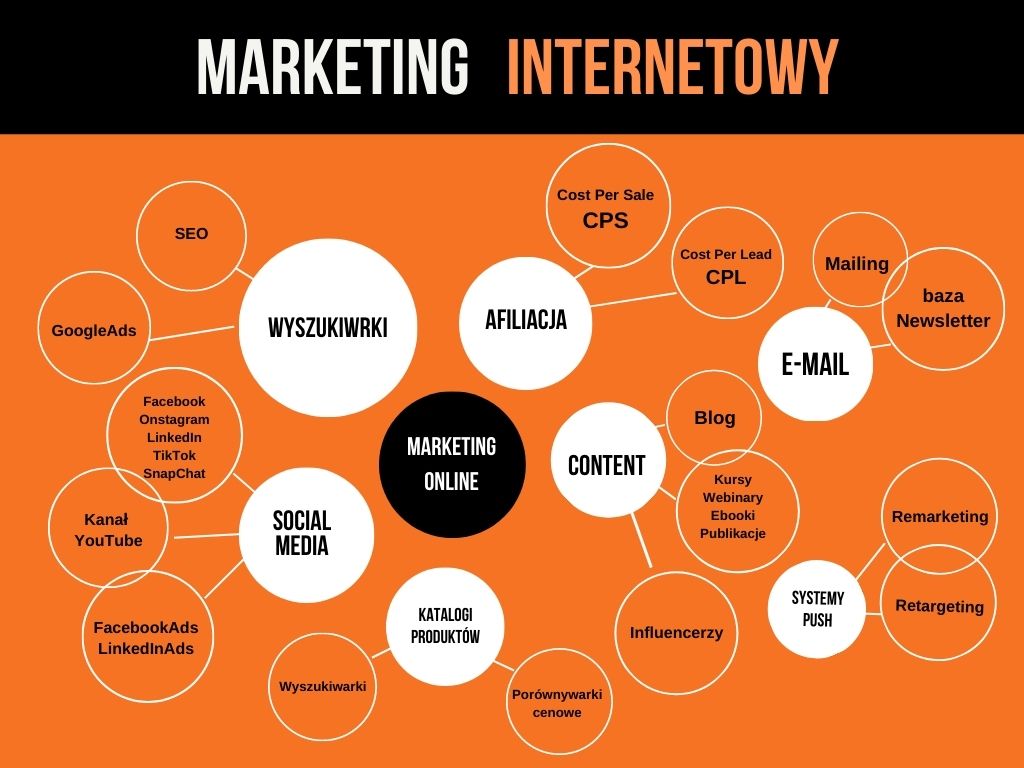
Advertise and pay only for sales results
Affiliate marketing – performance-based online marketing
Affiliate marketing for e-commerce is online marketing settled strictly based on sales performance. Publishers promote an advertiser’s products on their online platforms as part of partner programs. Publishers earn a commission from each sale, and advertisers increase their revenue thanks to these recommendations.
Through a partner program, advertisers can (via an affiliate network) make their offer available to an unlimited number of publishers. Publishers, on the other hand, gain access to partner programs and all the tools needed to promote products on their own channels. The affiliate system provides complete technical infrastructure and support so that cooperation runs smoothly and brings mutual benefits.
For example, if you run an online shoe store, you can launch a partner program that attracts publishers with audiences matching your target group. A fashion blogger, a YouTuber running a fashion channel, a lifestyle Instagram creator, or other websites featuring fashion products can all become publishers. Each of them promotes selected products from your store using affiliate tools provided by the affiliate network: widgets, banners, or affiliate links. If a user makes a purchase based on their recommendation, you as the advertiser (the store owner) pay the publisher a previously agreed commission calculated from the value of that sale.
More about cooperation with publishers in affiliate marketing can be found here: Partner program for an online store.

Affiliate marketing benefits every party involved. It generates higher sales for advertisers and enables publishers to earn money from their online presence without having to invest in their own store or product development.
Case study – affiliate marketing for the beauty industry – see more HERE
The biggest advantages of online marketing
Running an online business requires constant vigilance because the digital market evolves rapidly and continuously. Adapting to fast-changing user behavior driven by technological progress is not easy. At the same time, online advertising offers numerous benefits, and the most important include:
-
reaching potential customers 24/7,
-
access to detailed audience data, allowing for better personalization and communication tailored to real expectations and needs,
-
automation of certain marketing processes, which saves not only time but also money,
-
the ability to measure actions and results, and optimize them to achieve better performance.
Online marketing – strategy
Developing a comprehensive online marketing strategy is a complex and time-consuming task, yet essential for driving sales growth. Understanding and applying the key principles of digital marketing significantly improves the effectiveness of online activities. A strategy helps structure promotional efforts and shape communication methods. It defines primary and secondary goals, the methods for achieving them, and the marketing communication channels. The backbone of a marketing strategy includes:
-
defining achievable goals and KPIs,
-
identifying the target audience,
-
conducting competitor analysis,
-
creating consistent communication,
-
selecting channels for marketing activities,
-
analyzing ongoing actions.
Online marketing – goals and KPIs
The primary objective of online marketing for e-commerce is to increase interest in a product or service, ultimately leading to higher sales. To achieve this overarching goal, businesses typically need to set and accomplish intermediate goals according to the established strategy. Online campaign objectives can be divided into branding and sales categories.
Branding objectives:
-
increasing brand and product awareness
-
educating the market
-
distributing content
Sales objectives:
-
increasing engagement and the number of inquiries
-
increasing the number of users and customers
-
increasing sales
Key performance indicators are directly linked to the goals set earlier. In the area of online marketing objectives, many types of KPIs can be identified and measured using various marketing tools.
The list of potential performance indicators in online marketing campaigns can be virtually endless—each goal has its own set of metrics. They depend on the e-marketing tools used and the strategy adopted by a given company. Among the most popular KPIs are:
-
number of visits/sessions on the website
-
average session duration
-
number of new and returning users
-
conversion rate (CTR, i.e., the ratio of sales to users)
-
cost of acquiring a user/customer
-
average order value
-
number of newsletter sign-ups
-
number of new likes and shares on social media
-
social media engagement
How to define a target audience in online marketing
Precisely identifying who your offer is intended for is one of the most important elements of any marketing strategy. Only when you clearly understand who your target audience is can you communicate with them effectively using the right channels. It is worth defining in detail the characteristics of the people you want to reach. Important factors include age, gender, place of residence, financial status, profession, and interests—everything that may influence their likelihood of making a purchase in your store.
At the same time, it’s important to remember that the person who uses the product is not always the one who completes the purchase. Why does this matter? Take toys as an example. While toys must appeal to children, the actual buyers are adults—they are the ones spending their hard-earned money to make their children happy. To succeed, marketing communication must therefore convince adults that the toy is worth buying. The same applies to men’s cosmetics, which are often purchased by women for their partners. And expensive jewelry? It’s frequently a gift from a loving partner, so advertising messages must also reach the right group of men. This is why identifying the actual buyer of the product is essential when developing an online marketing strategy.
Defining your audience is now easier than ever. The digital world provides numerous tools to understand who your recipients are. With a business Facebook account, audience information can be checked using Facebook Audience Insights. Other social media platforms also offer statistics about followers and users who interact with your content. Google Analytics is another valuable source of data about visitors to your online store or website. Marketing platforms, thanks to the data they collect, allow precise targeting of advertising creatives—you can define exactly who should see the ad, including age, interests, and location.
Competitor analysis in online marketing
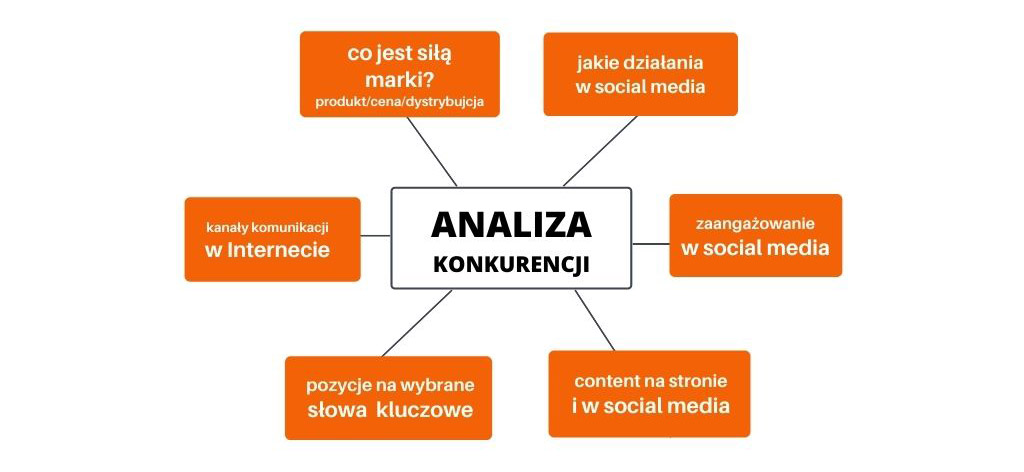
Competitor analysis—examining how other companies in your industry operate in the e-commerce market—can provide valuable insights and help avoid common mistakes. It’s worth reviewing how competitors communicate, where they advertise their products, which ad formats they use, and what online tools support their strategy. Key steps in competitor analysis include:
-
checking what products/services competitors offer and at what prices,
-
identifying the strongest attributes of the brand: quality, price, distribution, etc.,
-
analyzing competitors’ reach: average website traffic, Google ranking, number of social media followers, number of comments and positive reactions, quality of engagement, and more,
-
determining which online marketing channels they use: Google Ads, social media platforms, social media ads, content marketing, SEO, retargeting, etc.,
-
analyzing competitor positions for chosen keywords in search engines,
-
reviewing the content on their website—whether they run a blog and what topics they cover.
SEO, i.e. website positioning – organic online marketing
SEO (Search Engine Optimization) is one of those elements of online marketing that is often recommended in the first place, and not only for online stores. The foundation of effective SEO (positioning) is good content on the website, which is why SEO is inseparably linked with content marketing. Valuable and unique content brings measurable financial benefits, so it’s worth taking care of it already at the very beginning of building your online service.
Thanks to good SEO you get high organic positions in Google. Organic search means traffic that does not come from paid Google Ads campaigns. Why, then, do some pages appear higher on the list than others? Google’s algorithms, which evaluate the content on the site, must consider that content valuable for a given topic. Only then do they push it to high positions. This is influenced by both off-site and on-site activities as well as the content across the entire website. Interestingly, the website is evaluated holistically, which is why it is necessary to ensure good, substantive content, SEO optimization and an appealing design across the whole site, not just on a specific subpage that is being positioned.
Everyone who owns an online store wants customers who search for something on the Internet to end up in their store. Good positioning makes this possible. If someone types “leather high-heel shoes” into Google, the site for which appropriate SEO actions have been taken should appear in the first few positions, right below the ads. However, it should be remembered that positioning is a process that takes time. Achieving high positions in the search engine requires time. Sometimes it is a month, sometimes several months, and sometimes even more than a year if popular keywords are involved. Everything depends on the industry you operate in and on how much work is put into positioning. SEO results also depend on:
- the content that appears on the site (among other things, it must be consistent with the phrases you are trying to rank for);
- proper optimization of all necessary elements (titles, headings, image descriptions should contain keywords);
- the loading speed of the website;
- the use of tools necessary for SEO;
- analysing the activities carried out and drawing conclusions from them.
If you want to know much more about positioning, take a look at our article “SEO tools”, which contains essential information about the tools necessary for SEO activities.
Google Ads – paid online marketing in Google
Positioning ensures top positions in the search engine. However, organic results most often appear only as the 1st–3rd search result, which corresponds to… the middle of the visible page! The first part is usually taken up by paid Google Ads. You can prepare such ad creatives in a panel that you can access simply by logging in with an email account, and then optimize them for a specific URL (in this case your store). When preparing an ad in Google Ads, you can target it very precisely, because you reach people who type in a specific string of words or a single word, e.g. “jewellery made of natural stones”, “Toyota car”, “carp bait”, “water ball for party” or “table”. Match types also help with proper ad targeting. There are three variants:
- Exact match, which allows the ad to be shown only to those people who type in the exact sequence of words, e.g. “leather shoes”. If someone enters “shoes leather” or “brown leather shoes”, the ad will not be displayed.
- Broad match is when an ad targeted to the phrase “leather shoes” is shown not only to people who type “leather shoes”, but also to those who type “Leather shoes” (change in letter case), “shoes made of leather” (change of wording but the meaning remains the same) or make a spelling mistake or typo (“lether shos”).
- Phrase match, in turn, allows an ad targeted to the phrase “leather shoes” to be displayed also to people who type “brown leather shoes”, “leather shoes for sale” or “used leather shoes”.
In addition, Google Ads allows you to target ads based on location, age or other demographic data that distinguish users. Thanks to this, you can reach a very specific group of people.
Another option is online marketing carried out on social media, i.e. on Facebook, Instagram, LinkedIn, TikTok or YouTube. Taking care to build a community around your own brand is very important in today’s online world. Social media help you gather potential customers who so far have not known your products but belong to your target group. A huge advantage of advertising in social media is that you can reach, with great precision, people who are within your target. You can direct your ads to people of different genders, places of residence, professions, as well as people with different interests or views.
Social media play a big role in online marketing, but you should approach these channels thoughtfully and introduce them into your activities gradually. It is actually better not to have a Facebook or Instagram profile at all than to have one where nothing is happening. Each of these media has its own specifics and a defined way of operating, which does not work for every industry. So analyse carefully which medium is the best for your brand before you invest time and resources in it.
Facebook – still the largest online marketing network
Facebook was created in 2006. It’s hard to believe that the first version of the site was designed only with Harvard students in mind, and at the time of launch Mark Zuckerberg was just 20 years old. The service became hugely popular on the day it was launched – more than two-thirds of the students registered on the newly created site in the first two weeks of its operation.
Although many people keep predicting the imminent end of Facebook, it is still gaining users and it is hard to imagine the Internet without this portal. Over 2 billion users worldwide use it, and in Poland – 47% of the population, i.e. over 18 million people. These numbers alone show the enormous marketing potential hidden in this social medium. The question, however, is whether advertising an online store on Facebook is really a good solution.
Advertising on Facebook can take various forms, e.g. an image (a single graphic) or video material. Advertising an online store on Facebook often also takes the form of so-called collections or carousels – they allow you to present specific products to the customer, including those they have previously searched for. The great freedom in creating ad creatives makes it possible to plan campaigns of a different nature – the platform itself lets you set a goal. In e-commerce, campaigns are most often run either with a view to increasing reach and brand awareness, or to achieving a specific conversion.
The most popular advertising objectives on Facebook are:
-
brand awareness
-
engagement under a post
-
gaining fans
-
redirecting to any website
-
conversions: sale / download / leaving contact details
-
sending a message
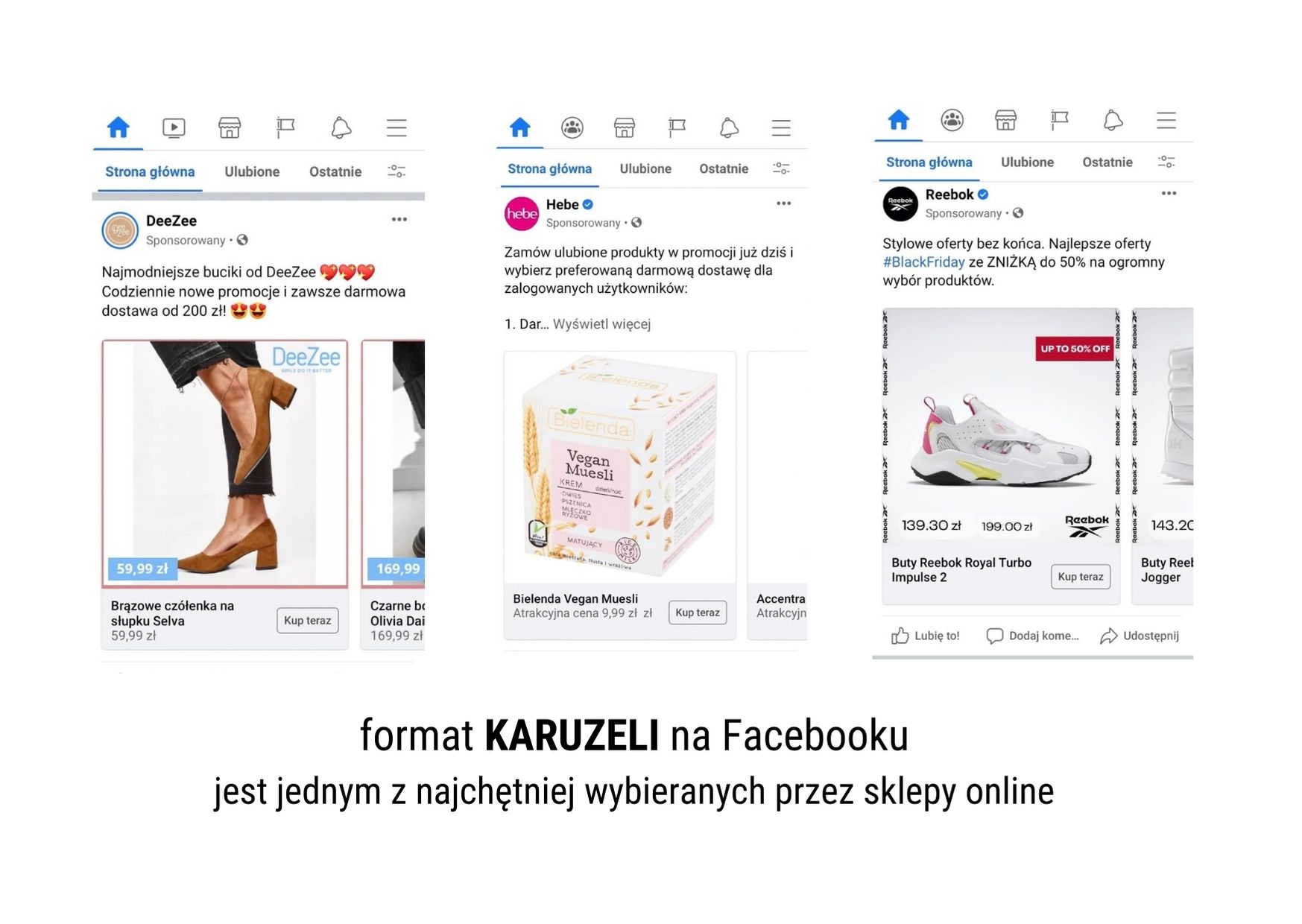 Above are examples of Facebook ads for online stores in the form of a carousel. A carousel ad makes it possible to show many products from a specific catalogue. You can add the product name and its price as well as a link that takes the user directly to the product in the store. If you want to learn more about advertising on Facebook or Instagram, we invite you to read our article on online advertising.
Instagram – the fastest-growing online marketing platform
If you run a jewellery store, a clothing boutique, an online bookstore or any other type of business where you offer interesting products, both physical and digital, Instagram is an option for you. Why? Here are some facts that will certainly interest you:
-
Instagram currently has over one billion users worldwide, 60% of whom log in every day.
-
2.2 is the engagement rate among users. That seems low? Facebook reaches just 0.22!
-
Instagram users interact with over 4 billion posts every day.
-
72% of users say they own a product they noticed in the app.
Source of data: https://www.websitehostingrating.com/pl/instagram-statistics/
As you can see, it’s a huge platform used not only by private individuals but also by many companies. In the US, as many as 71% of businesses use Instagram as a way to run their online marketing.
 Currently, video is the most popular format on Instagram. The engagement rate for video posts is 38% higher than for image posts. Insta Stories in particular reign supreme – many people literally start their day with them. You can learn more about the possibilities of Instagram Stories here. Ads on Instagram are created in Facebook Ads Manager, because Instagram has belonged to Facebook since 2012.
When preparing an ad creative, you need to remember that it should be:
-
interesting – ideally surprising from the very first moment, because you have only fractions of a second before the customer “swipes away”,
-
short but to the point – this is a requirement of the ad system.
Price comparison websites – online marketing for e-commerce
Price comparison websites are online services that present offers from thousands of online stores in one place. Thanks to advanced tools and filters, they allow users to compare the same products across different shops. This means that without having to visit each store directly, we can compare product prices in many places. We can also search for similar products or products within a given category to check what offers are available on the market.
Due to the constantly growing number of online stores, users don’t have time to browse all the shops they know that might sell the product they want, let alone to go through most of the options available on the Internet. Most therefore use price comparison websites, such as Ceneo. It is enough to enter the exact product name to receive a list of stores along with the current price. It is worth establishing cooperation with such services because, thanks to their popularity, they can drive a large amount of traffic to online stores.
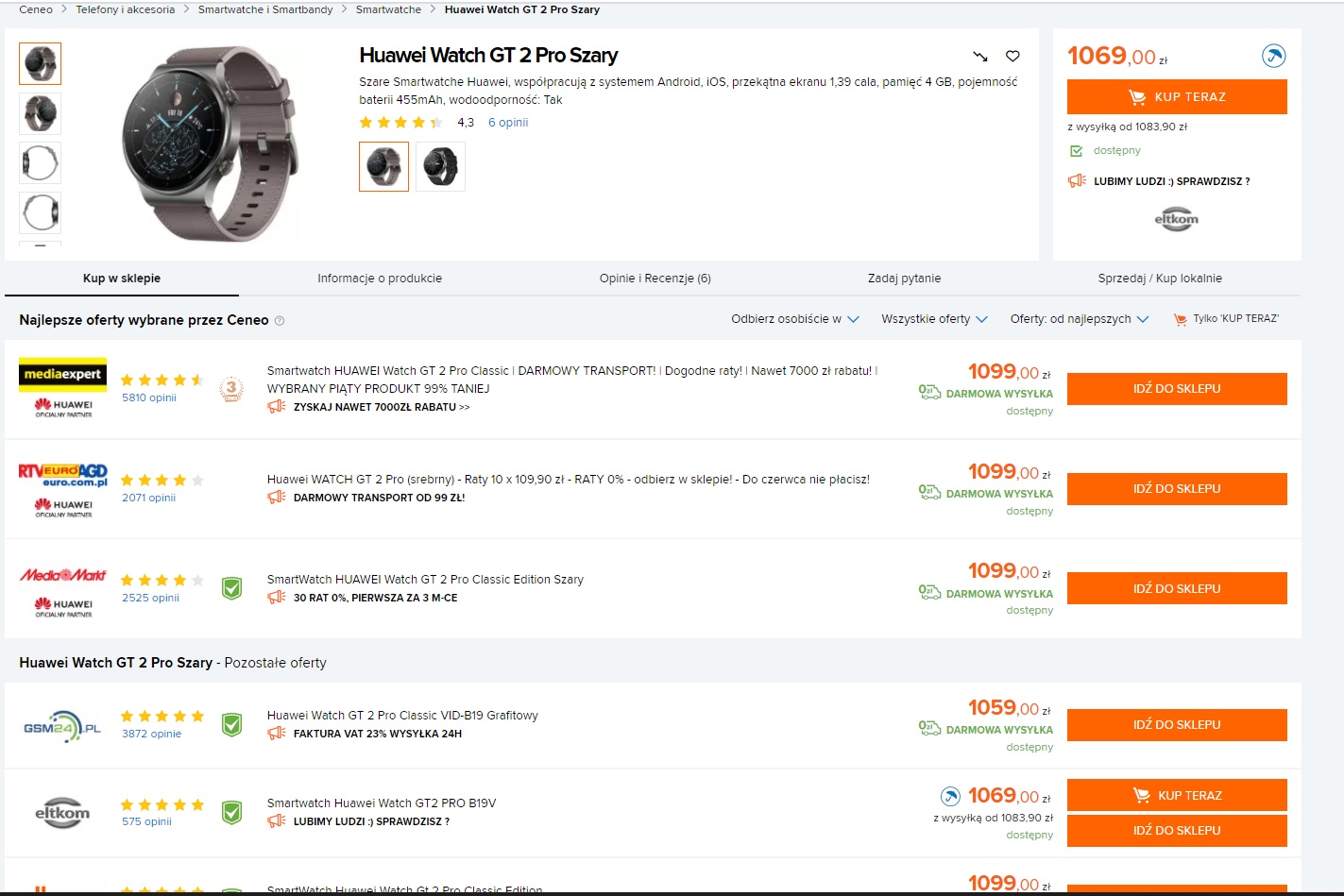
Searching for a specific product in the Ceneo price comparison engine. As you can see, offers from giants such as Media Markt or Huawei appear there, as well as from smaller e-commerce stores, e.g. GSM24.pl.
Analysis and measurability – the greatest value of online marketing
The biggest advantage of online advertising is the fact that, thanks to online marketing tools, we are able to precisely check whether the marketing activities we run actually achieve the intended indicators and goals.
Facebook Ads Manager or the Google Ads panel are professional tools that provide detailed statistics on ongoing advertising activities. All affiliate activities also make it possible to accurately analyse how publishers are performing in the partner program. It is also worth using basic, free tools such as Google Analytics or Page Speed Test and analysing key data from the website. Additionally, a good solution is to use the Google Trends tool, which allows you to learn about current search trends at any given time.
Remember that reliable analysis of your activities is the road to success. It allows you to determine whether you are staying within the agreed budget, which actions are effective, and which do not translate into conversions at all and have no chance of paying back the funds invested.