How to make money on Facebook with affiliate links — best practices
A publisher (e.g., a Facebook user, online creator, or influencer) can earn money by recommending products online—without having to own those products.
A publisher recommends products from online stores and earns a commission on their sale after joining an affiliate (partner) program. Everything happens virtually and online. The first step to start earning from affiliate marketing is registering in an affiliate network as a PUBLISHER.
How to make money on Facebook with affiliate links
The best and simplest way to monetize your activity on Facebook is through affiliate links. Facebook offers many options for posting active links that lead outside Facebook to other websites, including affiliate links. That’s why making money on Facebook can be so effective.
If you have your own fan page with a community around it, or you’re otherwise active on Facebook, you can start earning right away. By recommending products to your followers on your own timeline, in themed groups, or in comments—and attaching affiliate links to those recommendations—you can earn commissions on the sale of the products you promote.

Active affiliate links can be pasted directly into the body of a post, into the description of an image or video, or into a photo album. You can also paste just the link without any additional text. That’s why creating posts with affiliate links doesn’t require any extra skills. When you create an affiliate post, you work exactly as you always do—just additionally attach the affiliate link in the chosen place.
Why affiliate links work on Facebook
Affiliate links allow you to recommend products in a creative way. If we recommend products that match the theme of our fan page, we add extra value—because we’re suggesting products that can be quickly purchased online. This saves our audience time, and today time is the most valuable currency. They no longer have to search the internet on their own for information about specific products or look for trusted places to buy them.
For your affiliate link on Facebook to actually redirect and generate commission, first make sure you’re using the complete, correct version of the link provided by the affiliate program. If the network generates a long, awkward URL, paste it directly into the post text, making sure to keep the “https://” prefix so Facebook recognizes it and processes it properly—only then will it display as a clickable link.
Also pay attention to the format: don’t break the link with spaces or special characters, because that can interrupt it and change it. If you want to use links in comments or in groups, the rule is the same—paste the entire, full address. When you create a post on a fan page, you can additionally use the “Call to Action” (CTA) button and place your affiliate URL there—then the button will be clickable and will take the user straight to the offer.
Finally, remember transparency: add a short note to the post such as “#ad” or “#affiliate” to comply with Facebook’s rules and applicable regulations. This way your link will not only work technically, but will also build audience trust, which can translate into higher conversion.
How to start earning money on Facebook
To start earning on Facebook with affiliate links, you simply need to register as a publisher in an affiliate network. Registration as a publisher in an affiliate network is free (it has been and will remain so), as is access to all promotional tools and the full functionality of the affiliate platform. That’s why affiliate links you generate once can keep working for you until you remove them from your own online channels.

Free affiliate tools for earning money on Facebook
Why doesn’t a publisher need to pay any costs to start earning right away?
Because what matters most to advertisers and the affiliate network is building long-term cooperation with publishers—and for that cooperation to grow steadily, even if at the beginning it doesn’t bring measurable benefits to both sides. Charging publishers for using affiliate tools would mean most of them wouldn’t join the program at all, or they would end the partnership before their revenue exceeded their costs.
How to make money on Facebook — the art of choosing affiliate programs
The key to a publisher’s success is selecting the right affiliate (partner) programs. By joining programs that match the topics the publisher covers on their communication channels, they will appear credible in the eyes of their audience. This is therefore the basic thing to take care of at the start of an affiliate partnership in order to gain benefits from it.

You can check the full list of all partner programs in the webePartners network HERE.
Making money on Facebook — an affiliate link as a post
It’s a trivially simple task. After generating an affiliate link, you place it directly in the body of the post. After pasting it, you should add a suitable, prepared graphic (for link posts, this is most often 1200×628 pixels). You can change the link name by clicking on it and typing your own—just like in the image below. Also remember to add some text content: an affiliate link posted on its own is unlikely to encourage users to click, but with the right content, it becomes an effective way to earn money on Facebook.
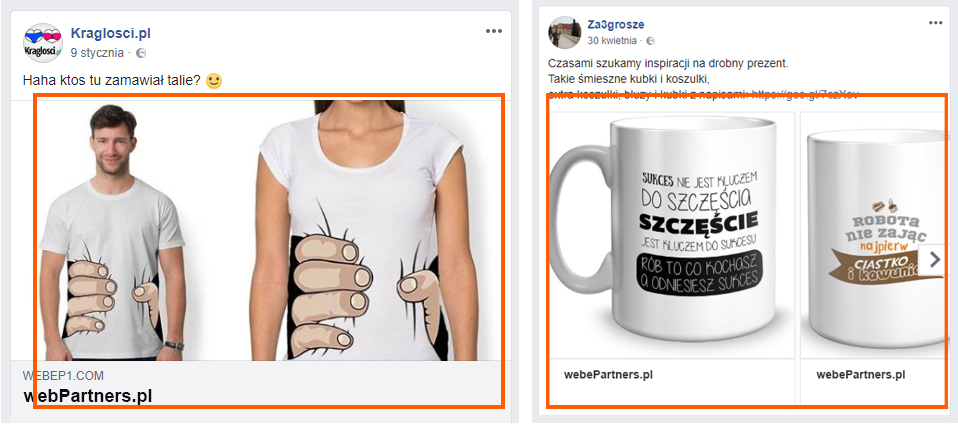
Making money on Facebook — an affiliate link in the post text
The most popular method is to paste the affiliate link into the post text. The example below illustrates it best:
Marek runs a fan page dedicated to TV series. For some time now, he has been active in affiliate networks and promotes advertisers’ products on his page. Marek knows how to make money on Facebook, and recently he published the following post:
“House of Cards is an incredibly engaging series about intrigues at the very top of American power. Excellent acting, gripping action, brilliantly developed storylines. I recommend it wholeheartedly! If you’d like to have the entire first season on DVD in your collection, click here: https://goo.gl/FNKCMU

An affiliate link included directly in the body of a post is also a way to earn money on Facebook. This form of promotion is well thought out, because the affiliate link is only a complement to the post content—not its main purpose.
If that’s still not enough for you and you’re still wondering how to make money on Facebook, we have another suggestion. It just so happens that Facebook offers the greatest variety of post formats among all social platforms. This also means it provides many opportunities to redirect users outside the platform.
Earning money on Facebook — “Get the look” and “Must have”
To learn how to make money on Facebook, we need to get to know our audience well. This makes it easier to choose the right products to recommend and, of course, improves click-through rates on our suggestions. Try to recommend things that are connected to your fan page’s topic and your audience’s interests. On Facebook (and not only there), all kinds of outfits, looks, and curated product sets from series like “Get the look” or “Must have” work very well.
Below is an example from the fan page of Karina Mrozicka, a stylist who regularly presents her followers with interesting outfit combinations. Her audience gets ready-made looks they can put together with just a few clicks, and Karina earns commissions from their purchases.
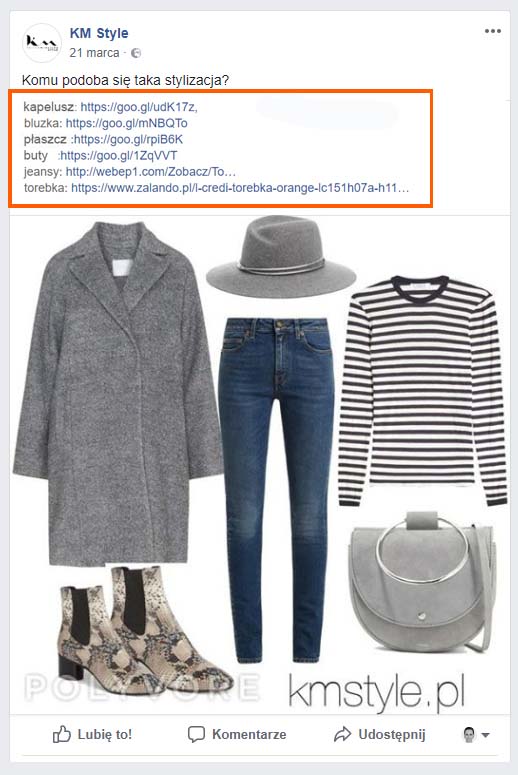
Earning on Facebook — affiliate links in photo descriptions
You can also add an affiliate link to a photo description. It’s very simple. All you have to do is share an image on your fan page and, when you choose the “add a description” option, include your partner link along with the post text.

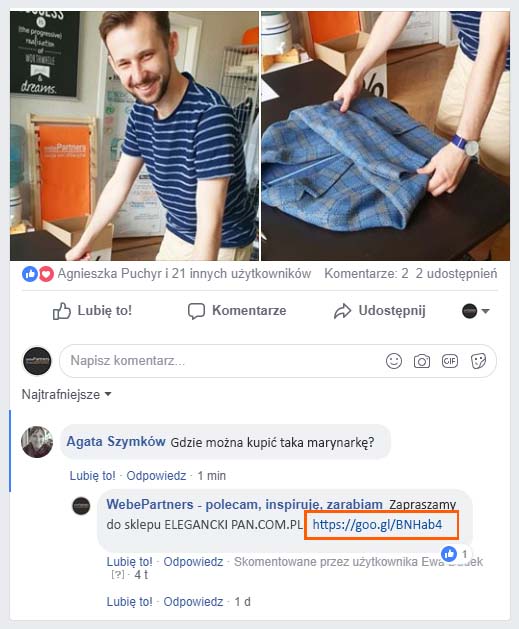
Earning on Facebook — a partner link in a comment and a private message
After publishing a post about the series House of Cards, Marek received a comment from Magda. It said: “I’m looking for a birthday present for my brother, who’s into fantasy. Could you recommend a TV series?” Nothing could be easier! Marek went to the website of a store he partners with and found an elegant edition of the first season of Game of Thrones. He replied to the comment like this: “Sure! How about this: https://goo.gl/WWB62K”.
Marek received a very similar question in a private message as well. He also recommended the series along with an affiliate link. Sending links via Messenger isn’t a problem, after all!

Recommend affiliate links directly in a private message. This is a good way to earn money on Facebook. In both of these cases, we’re dealing with a situation where the user reaches out for help and advice on their own, so there’s no question of being pushy or trying to convince them to buy at all costs. It’s a simple way to earn money on Facebook.
Remember that you can send affiliate links not only via Messenger. You can freely paste them into WhatsApp, Google Hangouts, an SMS, or simply an email. Any link you send in a private message or in a comment can be replaced with an affiliate link! This opens up many opportunities for you.
How to earn money on Facebook—and beyond
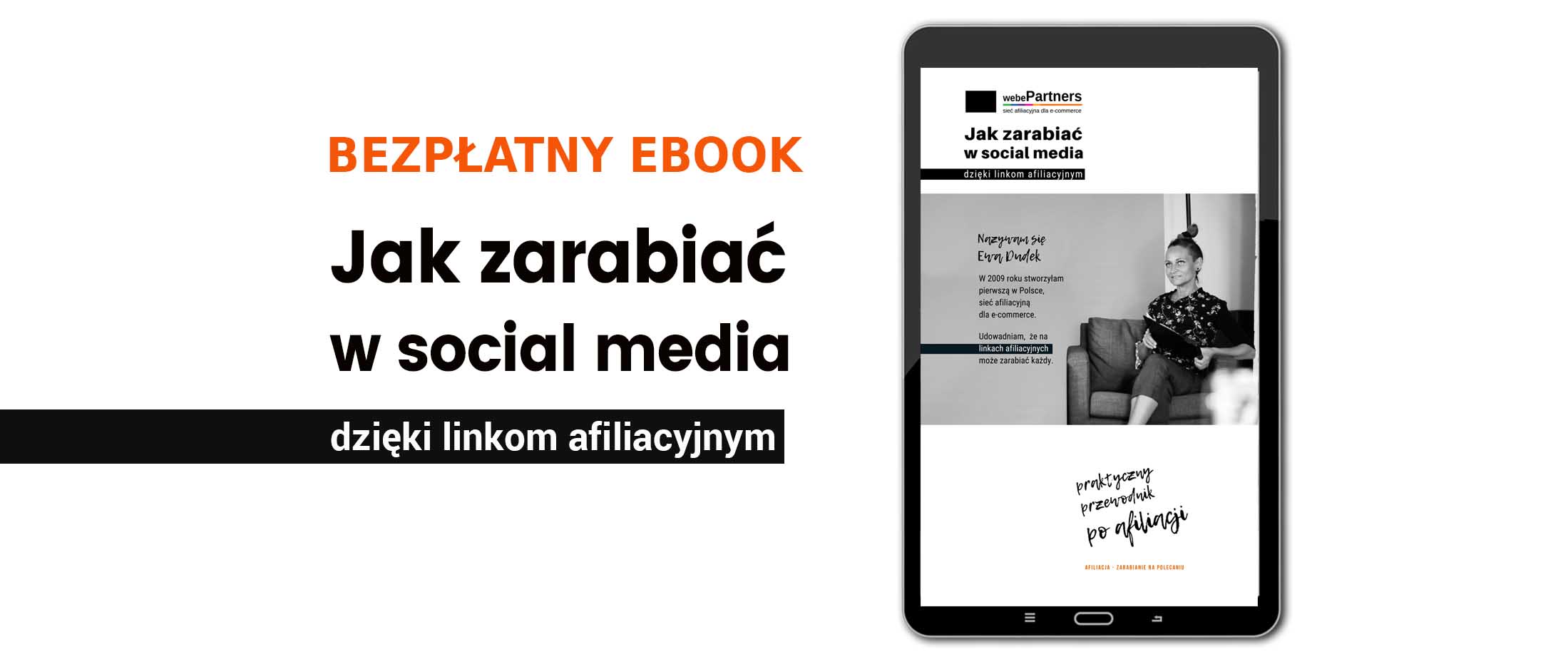
Facebook is one of many social media platforms where you can publish affiliate links and earn money. Similar opportunities are available on Instagram, YouTube, Snapchat, or Pinterest. If you want to learn how to monetize traffic on other social media platforms, we have a free e-book titled “How to Earn Money in Social Media.” Inside, you’ll find only practical examples of publishing affiliate links so you can monetize your activity.
Creating interesting posts on Facebook (or other social media) is an exceptionally difficult art. We’ve been hearing for years that good content is the foundation. We know it has to be engaging, creative, original… The problem is that these slogans have become worn out. That’s why in this article we’ll answer the question of what good content REALLY is.
How to create posts and content to earn money on Facebook
As we mentioned above, funding campaigns won’t help if the content we offer doesn’t stand out from other similar profiles—so it’s worth focusing on genuinely interesting Facebook posts. Paid posts simply boost reactions that would appear anyway under organic content. That’s why, before you decide to put a few złoty behind a post, it’s worth checking how it performs without promotion.
Unfortunately, not all marketers realize that money alone isn’t enough to deliver cool, high-quality content to users. What’s more, many of them still cling to the age-old sender–message–receiver model that we should have forgotten long ago! Of course, each of these elements plays an important role in communication, but we must remember there are also factors like cultural code, context, sensitivity, and so on. Therefore, when planning interesting Facebook or Instagram posts, we shouldn’t focus only on “what?” and “for whom?”, but also on how we want to communicate and what we want to achieve.
How to earn money effectively on Facebook — keep your content and formats consistent
Every brand runs its social media in its own way, with its own language and style. Users know perfectly well that they’re not talking to the CEO of Netflix, the head of Tesco, or “Mr. Mercedes.” Behind every piece of content there is an ordinary person—an employee of a creative agency or an in-house marketing department. And that’s fine, as long as it’s one person—but sometimes several people work on the same brand. That’s why consistency of messaging is so important, so that communication fits the brand regardless of who creates the content. Fans will quickly sense something fake, so it’s crucial that copywriters are properly prepared and familiar with the brand’s tone of voice.
Alright—this rule works for published content, but what about moderation, which also builds the brand’s image? Moderators are often external people who don’t take part in the content publishing process in social media. Yet they are responsible for building a long-term, positive relationship with users. In the case of truly large brands (e.g., retail brands), one moderator isn’t enough, so several people handle it. That’s why in this situation it’s worth focusing on greater directness and signaling that there’s a real person on the other side of the screen—someone like a staff member in a physical store.
Lidl Polska has done this very well: it offers its fans on Facebook creative and consistent communication, and in the comments it goes beyond the brand “script” and introduces a real, flesh-and-blood employee. Shortening the distance like this helps build a more personal relationship, which makes communication with users easier. You can find interesting Lidl Facebook posts very often. And the fact that comments are signed with the moderator’s first name is also a great idea. No wonder the discount chain enjoys the greatest popularity in social media and leaves the competition behind.

How to earn money effectively on Facebook — the simpler, the better
Age, gender, race, interests, place of residence, religion—when targeting ads on social media, we can take even the smallest details into account. We also hear these terms often in the context of a brand’s users, when we want to define them before rolling out communication. The problem, however, is that we won’t create good content for an “ideal” target group we assumed in advance. Since every group includes members who stand out with individual traits, when creating content we can’t limit ourselves to dry labels—we have to use our imagination.
Even within a strictly defined group, there are individuals for whom a brand’s communication will be difficult or unclear. That’s why it’s sometimes worth choosing a simpler, more understandable message to make sure we reach more users. This applies both to the content itself and to all additional activities, such as encouraging comments or participation in a contest. No one feels like liking, sharing, or writing long explanations of their answer. Sometimes, the simpler, the better!
Social media — from people to people
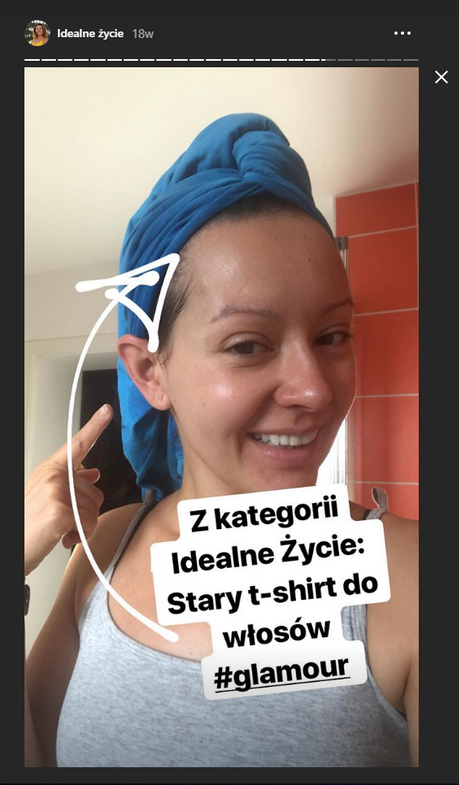
Content isn’t only top-quality copy—it’s also everything we publish on our social media and the glimpse we give into our everyday life. Today, in a time of “content reduction,” a single photo with a hashtag and a one-sentence caption can be enough. However, what matters even more when creating this type of content is reversing the trend. Users no longer want to look at beautiful, posed photos from professional shoots—they want to see real people! It’s worth remembering this if you’re building a following as a public figure
Affiliate marketing on Facebook makes it possible to monetize your online activity without needing to have your own website. What’s more, there are really quite a few ways to place an affiliate link there. Let’s not forget, however, that when running a fan page we should above all provide attractive content to the people who “like” us—so promote affiliate offers thoughtfully and in moderation!