Affiliate system for e-commerce – a tool for implementing affiliate marketing
What is an affiliate system for e-commerce?
Affiliate marketing is a form of promotion based on cooperation between online stores and publishers within an affiliate program. The goal of this cooperation is to generate measurable financial benefits for both the advertiser and the publisher.Online stores earn more because they sell more thanks to publishers’ recommendations, and publishers earn commissions on the transactions that are completed as a result of their referrals. This kind of cooperation is made possible by the affiliate system.

Affiliate system — technological backbone for publishers and advertisers
An affiliate system provides the full technical and organizational infrastructure that allows publishers (affiliates) to focus solely on promotion, and advertisers – on sales. In the user panel, each publisher gets a convenient dashboard where, with a single click, they can generate unique tracking links, banners, widgets and other graphic or text materials.
In the background, an advanced cookie-based tracking mechanism runs continuously, ensuring that all clicks and conversions are instantly recorded, assigned to the correct partners and displayed in real time in reports. The system automatically handles commission settlement – it calculates payouts according to the agreed model (CPS, CPL, CPA), keeps a complete payout history and issues automatic invoices or tax reports.
Who uses an affiliate system

An advertiser is simply an online store or online service provider that wants to promote its product and drive sales. A publisher, on the other hand, is a person who owns some kind of communication channel where information about such a product can be posted. The affiliate network provides the technology and tools — that is, the affiliate system — which enables cooperation between the publisher and the advertiser, then tracks all transactions and, on that basis, handles all commission payouts.
Affiliate system – who can be an advertiser
As mentioned before, an advertiser can be anyone who has a product to sell online and wants to promote it. In the webePartners affiliate network, advertisers are mainly online stores, as our technological solutions are dedicated to e-commerce. Thanks to this, online stores can be promoted by publishers in exchange for a commission on sales. This means that billing is done in the Cost Per Sale (CPS) model.
Affiliate system – who can be a publisher
Anyone who uses the internet and in any way communicates with other users can become a publisher. Although the entities with larger reach earn the most from cooperation with advertisers, even the smallest ones — who communicate only with their own friends via Messenger or WhatsApp — can become affiliate publishers.
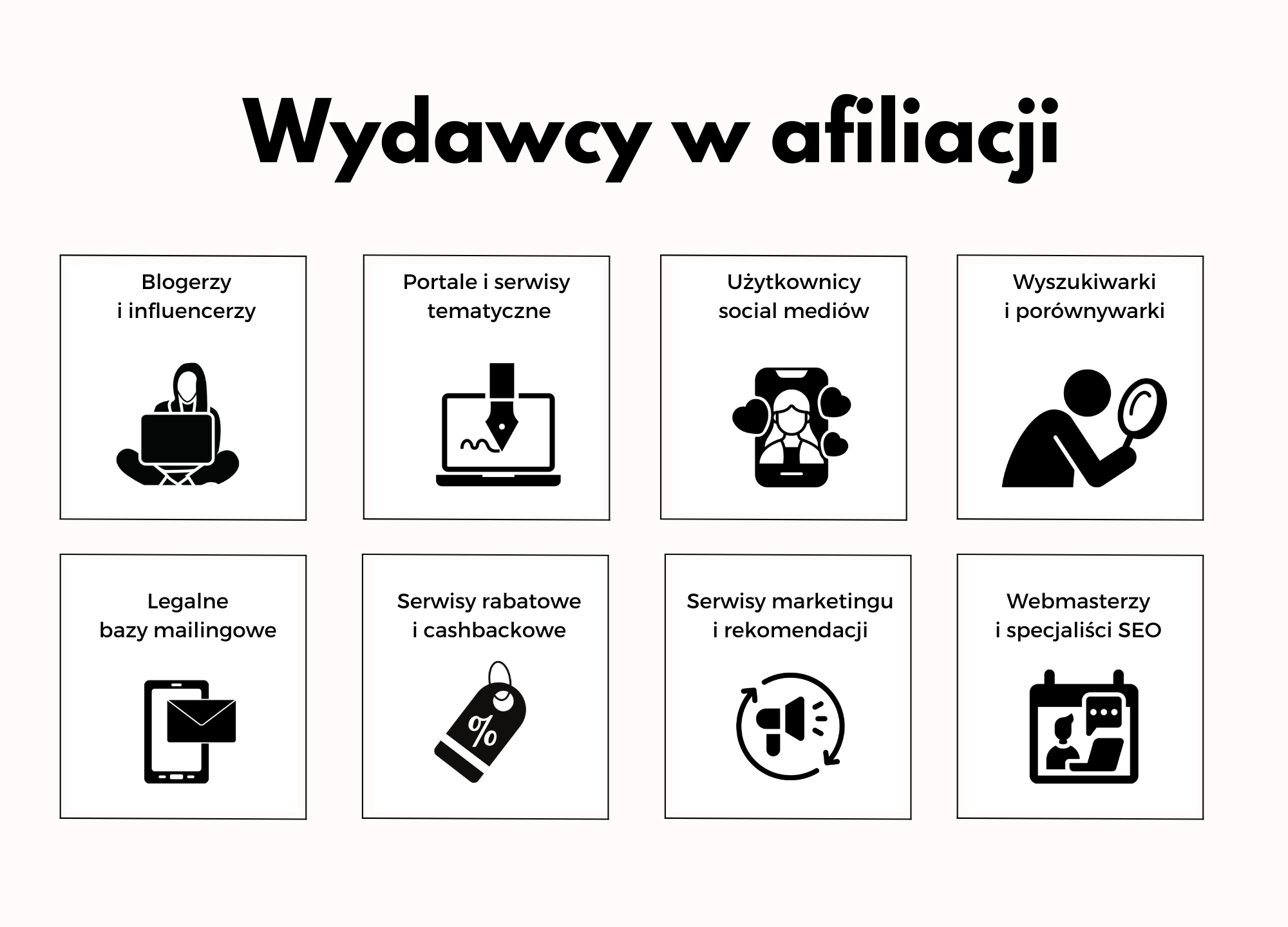
The largest groups of publishers:
-
Influencers and bloggers – people running their own websites (blogs) and complementing their activities with social media
-
Social media users (Facebook, Instagram, YouTube, Pinterest, Snapchat) who operate exclusively on social platforms
-
Niche websites and online magazines that distribute content within a specific topic or operate as multi-topic portals
-
Owners of legal mailing lists, who can send mailings to strictly defined target groups
-
Price comparison sites and product search engines, which can present the advertiser’s entire offer or only selected products along with their photos and descriptions
-
Webmasters and SEO specialists
What are the costs of participating in an affiliate system?
The most common way of paying for performance marketing activities in e-commerce is the Cost Per Sale (CPS) model, i.e. a commission on the sales generated by the publisher for the advertiser. Importantly, a full transaction must take place: the buyer has to place an order, pay for it, receive the package and not return the goods.
Sometimes advertisers pay for clicks (Cost Per Click, CPC) or leads (Cost Per Lead, CPL), but this is relatively rare in the case of online stores. Paying for leads — e.g. for a submitted phone number or a completed form — works much better for services. Paying per click is typically used when a store is building its brand and wants to increase awareness alongside affiliate activities.
As for settlements with the affiliate network, it also charges a commission fee, which depends on the amount of sales generated by publishers for a given online store.
Affiliate system – available advertising formats
Through its own affiliate system, the affiliate network provides publishers with a range of free tools that allow them to present the advertiser’s offer in many different ways, across various ad spaces.
The most popular ad types are:
Affiliate links, considered the simplest affiliate tool. Such links can be generated in just a few moments. This is a unique URL of any page belonging to the advertiser. Each click on this address generates a visit to the advertiser’s website. Thanks to the affiliate link, which has the publisher’s unique ID encoded in it, you can track not only the number of page views resulting from that link, but also all actions and sales, as well as the commissions from those actions.
- In social media – e.g. by publishing posts with a link on Facebook or creating Instagram Stories using the “swipe up” option, i.e. placing the URL directly in the story
- On YouTube – under videos (in descriptions), where you can add an unlimited number of affiliate links
- On blogs – bloggers in a given niche publish articles, reviews or lifestyle content, where they weave in content with affiliate links to the advertiser’s products. Importantly, affiliate marketing in this case can be done in a very subtle and natural way
- In mailings – where the affiliate link is attached to a graphic or naturally incorporated into the email copy
-
Banner ads – these are graphic creatives that promote a website or a product. It is essential that they contain an affiliate link to whatever they promote. Banners are meant to encourage the customer to click, so they need to be designed in an engaging way. It’s worth knowing that every banner in the affiliate network automatically has an affiliate link assigned to it, which makes it perfectly clear what commission should be paid to the publisher who displayed it on their online space. Keep in mind that banners can appear only on websites, platforms, apps or blogs – this follows from their very nature and format.
Product widgets – these are used as an alternative to banners. It’s a type of creative where selected products are arranged in a grid (tiles), each with its image, price and name. Every product is linked with its own dedicated affiliate link, which makes it possible to track all key parameters (actions and sales, clicks, commissions, etc.). Widgets can also be used only on websites or in certain applications. This is because widgets are scripts, which makes it impossible to implement them, for example, in social media.
XML files – these are text files used for data transfer. They allow you to structure information in an organized way, which makes them useful across different platforms. In online stores, XML files are used to transmit data between the e-commerce database and price comparison sites or product search engines. Such files contain product images, names, prices, specifications and detailed descriptions – everything that is needed to present the product in an attractive way.
Benefits of participating in an affiliate system – Case Study
Competition in e-commerce makes companies look for optimized advertising methods. An affiliate system not only allows you to monitor the effects of your campaigns in real time, but also to reduce advertising costs. The commission-based Cost Per Sale model guarantees a stable cost level.
Case Study – affiliate marketing for the beauty industry – see more HERE
Cooperation between advertisers, publishers, the affiliate network and users is based on a win–win principle, because everyone gets what they need. The publisher earns money from their publications, the advertiser increases sales, the affiliate network receives remuneration for initiating and monitoring the processes, and the user discovers new brands and buys products they need thanks to recommendations from people and websites they trust.
Traditional ads are often perceived as intrusive or unnecessary, which is why users frequently ignore them. Well-executed affiliate marketing makes promotional creatives subtle and even genuinely helpful for users, who often don’t even realise they’ve clicked on an ad – which makes them more willing to use them.
As you can see, affiliate marketing is not as complicated as it might seem. It can, however, lead to outstanding sales results. If you run an online store and want to promote your products, you absolutely need to give it a try!